🚨 Sensitive U.S. F-35 Fighter Jet Parts Reportedly Ended Up in China’s Hands After Being Diverted to Hong Kong
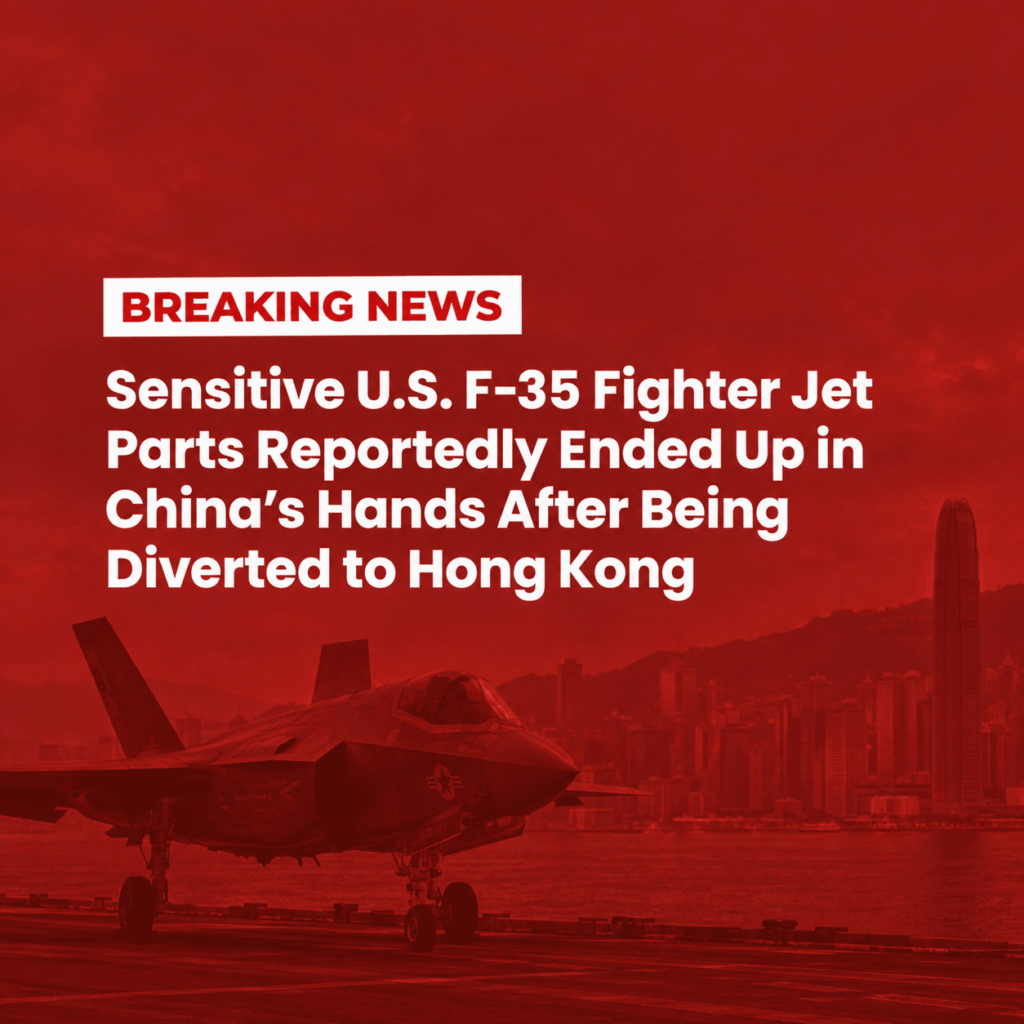
A shipment of F-35 fighter jet parts sent from Australia for repair in the United States was diverted to Hong Kong in late May, prompting investigations by the Pentagon, Australian defense officials and U.S. congressional committees, according to people familiar with the matter.
The shipment, handled by delivery company UPS on behalf of manufacturer Lockheed Martin Corp., included a cockpit canopy and a weapons-bay door from an Australian military F-35. Both components were coated with a radar-absorbing material that contributes to the jet’s stealth properties, according to people briefed on the incident. The aircraft parts stopped in South Korea en route to the United States and were then routed to Hong Kong, a special administrative region of China, one of the people said.
The U.S. Defense Department’s F-35 Joint Program Office is working with Lockheed Martin and Australian officials to recover the components. Congressional national security committees have received a series of closed-door briefings on the matter from State Department and Pentagon officials beginning in June, with additional sessions expected.
It has not been established why the shipment was diverted, or whether the reroute was deliberate or accidental. The Joint Program Office said in a statement that it was aware of a shipment issue involving unserviceable F-35 components and was working with U.S. authorities and industry partners to retrieve them, investigate the episode and add safeguards against a repeat.
Extent of possible exposure disputed
Accounts differ on how much access China may have gained. People briefed on the incident told Bloomberg that the Chinese government has taken possession of the parts. Earlier reporting by Politico, which first disclosed the diversion on Sept. 18, said it was not clear who currently held the components. There is no public evidence that Chinese authorities or the People’s Liberation Army have examined them.
Australian Defence Minister Richard Marles, addressing reporters on Sept. 22, said Australia was assisting the U.S. and Lockheed Martin with the investigation and that, as he understood it, no sensitive parts were included in the shipment. That assessment differs from the description given by people briefed on the matter, who said the canopy and door carried the radar-absorbing stealth coating. J.J. Gertler, a military aviation analyst with the Congressional Research Service and a former House Armed Services Committee staff member, said physical possession of a part could let an adversary verify or refine intelligence it had already gathered through other means, even if it already held technical specifications.
Company and government statements
Lockheed Martin, which manages the F-35’s global supply chain and uses commercial carriers to move parts between countries, said it complies with all U.S. requirements for delivering aircraft components but could not disclose the status of individual shipments for security reasons. The company said its teams handle every shipment with safeguards meant to protect the F-35 program and its partner nations.
Officials at separate briefings held by China’s foreign and defense ministries said they were not aware of the situation. The Hong Kong government declined to comment when contacted by CNN; the U.S. consulate in Hong Kong referred inquiries to the State Department. Lockheed Martin, UPS and the Pentagon did not immediately respond to requests for comment from CNBC.
The Australian outlet The Nightly, citing unnamed defense-industry sources, identified the shipping intermediary as CEVA Logistics, a French-owned freight company; CEVA did not respond to requests for comment, and the claim has not been corroborated elsewhere.
Background
The F-35 Lightning II, built by Lockheed Martin, is a fifth-generation stealth fighter whose sale the U.S. government restricts to close allies and partners. Eight countries — the United States, Britain, Australia, Italy, the Netherlands, Canada, Denmark and Norway — are program partners, and twelve additional countries, including Israel, Japan and South Korea, operate the aircraft under separate agreements.
China has for years sought information about the F-35 through espionage, according to people briefed on the current case. Concerns that China could gain intelligence about the aircraft were among the reasons a proposed U.S. sale of F-35s to the United Arab Emirates, announced during Donald Trump’s first term, later fell through. Some members of Congress have raised similar concerns about a potential sale to Saudi Arabia.
The diversion also comes against a backdrop of broader supply-chain oversight problems. The Government Accountability Office reported in 2023 that more than a million F-35 spare parts had gone missing over the preceding five years.
What follows
The components have not been recovered, and the Joint Program Office has not said when the investigation will conclude. Further congressional briefings are expected in the coming weeks. It remains unconfirmed why the shipment was rerouted, whether the diversion was intentional, and whether Chinese authorities have physically examined the parts.
Sources
Reporting on the shipment’s contents and China’s reported possession of the parts is attributed to people briefed on the matter, as cited by Bloomberg; the initial disclosure and congressional-briefing timeline are attributed to Politico’s original reporting. Government and company statements are drawn from Pentagon, Lockheed Martin, Australian and Chinese officials as quoted across the outlets below.
Wire services and international press
- Bloomberg, “China Is Holding Sensitive F-35 Parts Diverted to Hong Kong.” https://www.bloomberg.com/news/articles/2026-09-23/china-is-holding-sensitive-f-35-parts-diverted-to-hong-kong
- CNN, “Australia confirms F-35 fighter jet parts were mistakenly diverted to Hong Kong.” https://www.cnn.com/2026/09/22/australia/australia-us-f-35-fighter-jet-parts-missing-intl-hnk
- CNBC, “Chinese authorities reportedly in possession of F-35 components in Hong Kong.” https://www.cnbc.com/2026/09/24/chinaf-f35-components-hong-kong.html
Local and regional press
- The Nightly (Australia), “Australia confirms investigation into missing F-35 aircraft parts feared lost in Hong Kong.” https://thenightly.com.au/australia/australia-confirms-investigation-into-missing-f-35-aircraft-parts-feared-lost-in-hong-kong-c-22909490
Background and original reporting
- Politico, “Hill investigates after F-35 parts diverted to Hong Kong” (Sept. 18, 2026), via syndication partner. https://freerepublic.com/focus/f-news/4396288/posts
- The Aviationist, “F-35 Spare Parts Diverted to Hong Kong, Prompting U.S. and Australian Investigations.” https://theaviationist.com/2026/09/22/f-35-spare-parts-diverted-to-hong-kong/
- The Week, “China reportedly holds F-35 parts diverted to Hong Kong.” https://theweek.com/defence/china-f35-parts-hong-kong-us
Editor’s note on sourcing The identity of the shipping intermediary was reported by only one outlet, The Nightly, citing unnamed defense-industry sources and noting the named company did not respond to requests for comment; it is included here with that attribution rather than as established fact. Whether the diversion was intentional or accidental, and whether Chinese authorities have physically examined the components, remain unconfirmed and are not asserted as fact above. Where Politico’s original story is cited via a syndication partner, the originating Politico URL should be substituted if that outlet holds the subscription.