SpaceX Says It Could Assemble Orbital AI Data Center by 2028
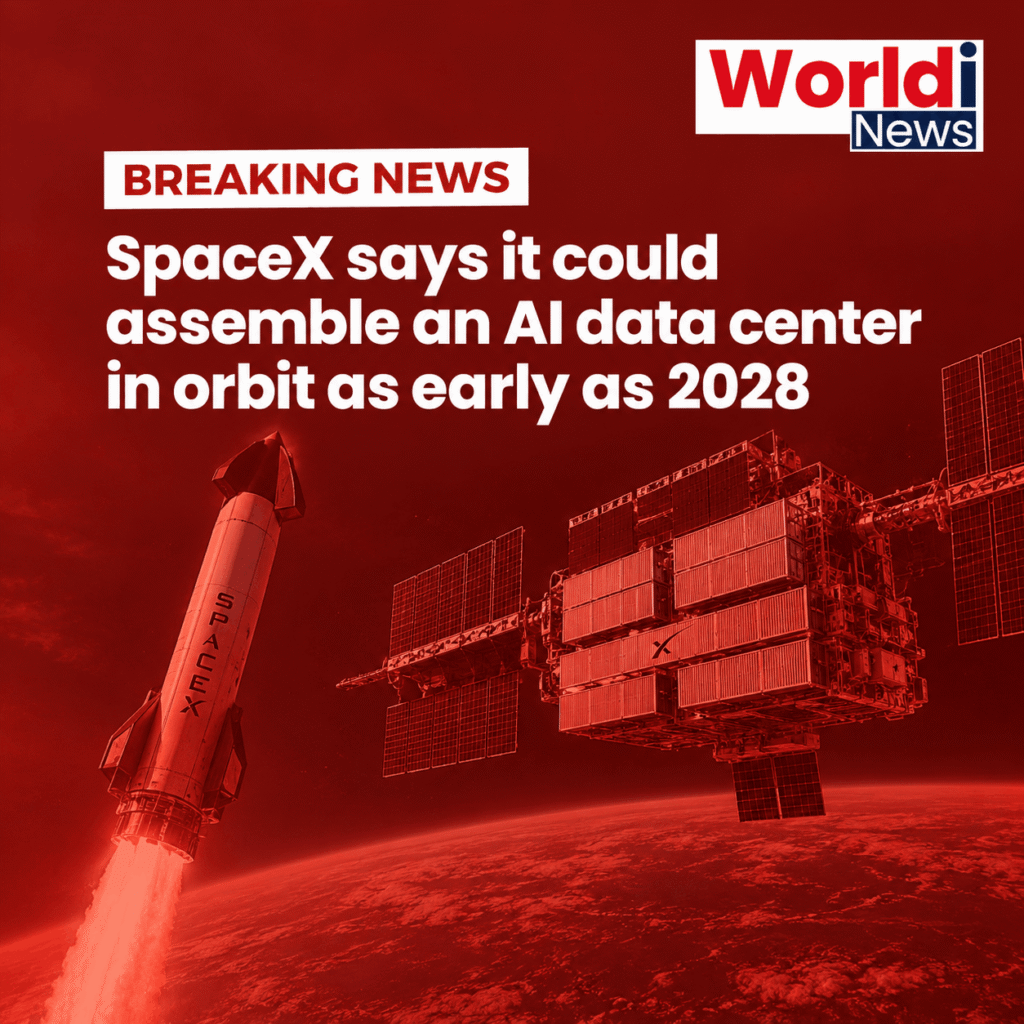
SpaceX said it could begin large-scale assembly of a satellite-based artificial intelligence data center in orbit as early as 2028, part of a wider push by the rocket company and its billionaire founder, Elon Musk, to move AI computing off Earth.
The company, in partnership with the chipmaker Nvidia, has designed a satellite called AI1 carrying Nvidia’s Vera Rubin NVL72 computing system, with an initial launch targeted for the fourth quarter of 2027 and what Musk has called “significant scale” reached in 2028. The AI1 design has a wingspan of about 70 meters and a deployed height of roughly 20 meters, with a solar array rated at 150 kilowatts peak output feeding a single compute module cooled by radiators, according to figures SpaceX has released. Musk has said the design is simpler, cheaper and lighter than a comparable rack of servers on the ground.
Because a large orbital data center cannot fit inside a single rocket, SpaceX and other companies pursuing the concept say the hardware will need to be built up from multiple satellites launched separately and linked together once in orbit, using robotic systems for in-space assembly that industry analysts say do not yet exist at the scale required. SpaceX has applied to the Federal Communications Commission for permission to launch as many as 1 million such satellites, describing the constellation in its filing as a step toward capturing more of the sun’s energy for AI-driven applications.
Musk has argued that computing in space sidesteps the electricity, water and land constraints that increasingly limit data centers on Earth, since solar power in orbit is continuous and unobstructed by weather. He has said the strategy leans on technology already proven in SpaceX’s Starlink satellite-internet constellation, including laser communication links, solar arrays and thermal radiators.
Nvidia deal and satellite design
The Nvidia partnership, confirmed by both companies in recent weeks, is intended to accelerate what Nvidia describes as agentic AI workloads — AI systems that take actions rather than simply generating answers. SpaceX said the compute hardware on its satellites is not locked to a single chip supplier, which analysts said may reflect difficulty securing AI silicon as much as a preference for design flexibility.
SpaceX went public in mid-June 2026 in a stock offering that outlets including Reuters, Bloomberg and the Financial Times reported was expected to value the company at somewhere between $1.5 trillion and $2 trillion, among the largest initial public offerings on record. SpaceX has said proceeds from the offering would help fund the orbital-computing effort alongside its existing launch and satellite businesses. In February 2026, SpaceX completed an all-stock acquisition of xAI, the AI company Musk also founded, which he said would let the two ventures build data centers in space together.
Skepticism over cost and physics
Independent researchers and rival executives have questioned whether the plan can be executed on Musk’s timeline, or at the scale described in SpaceX’s regulatory filing.
Sam Altman, chief executive of OpenAI, called the concept “ridiculous” at a media event, though he said orbital data centers could “make sense someday.” He cited launch costs and the difficulty of repairing computer chips in space as major obstacles for now.
IEEE Spectrum, an engineering trade publication, reported that cooling a single Nvidia H100 chip in orbit already strains available radiator technology, and that a 100-megawatt orbital data center would require thousands of square meters of radiator surface. Dina Genkina, the publication’s computing and hardware editor, was quoted saying Starcloud, a rival startup, had sent one Nvidia chip to orbit so far and found its radiator too weak to let it run at full power. The publication also noted that lofting 1 million satellites at SpaceX’s current launch cadence would take roughly a decade under optimistic assumptions, and that manufacturing them at Starlink’s present production pace would take considerably longer without a substantial increase in factory capacity.
Other analysts were less dismissive. Michael Pierce, principal at Technology Strategy Partners, said SpaceX’s existing satellite laser-link network gives it an advantage rivals cannot easily replicate, and that orbital data centers might reach cost parity with terrestrial data centers in five to ten years, though he said training large AI models — as opposed to running them — likely cannot tolerate the latency of a distributed system in orbit. Evelyn Chow, a portfolio manager at Neuberger Berman, told CNBC that meaningful scale in orbital computing was more likely a “next-decade event” than a near-term one.
Rivals also pursuing orbital compute
SpaceX is not alone in the effort. Google has said it aims to launch a test constellation of AI-processing satellites under a program called Project Suncatcher, in partnership with the satellite company Planet Labs, with an initial launch planned for 2027. Amazon founder Jeff Bezos’s space company, Blue Origin, has for more than a year worked on similar technology, according to a Wall Street Journal report cited by Reuters, and Bezos has said publicly that gigawatt-scale data centers will eventually be built in space, though he put that timeline at 10 to 20 years. The startup Starcloud has partnered with a separate firm, Rendezvous Robotics, to test spacecraft components designed to assemble themselves in orbit, with a goal of delivering “full-scale systems” in 2028, according to its executives.
Background
SpaceX filed its FCC application for the satellite constellation in January 2026, describing altitudes between 500 and 2,000 kilometers above Earth. The following month, it merged with xAI. Musk has since described the orbital-computing push in increasingly ambitious terms, at one point telling employees, according to a New York Times report cited by industry newsletters, that xAI would eventually need a factory on the moon to build the satellites.
What follows
SpaceX has not said how many satellites it intends to launch before 2028 or specified the total cost of the program. The company’s first demonstration launches are expected in the fourth quarter of 2027, which will test whether the compute hardware and cooling systems perform as designed before any attempt at larger-scale assembly. Independent verification of SpaceX’s technical claims about the AI1 satellite’s performance has not been possible, and the extent to which Nvidia chips can operate reliably in orbit over an extended period remains unconfirmed.
Sources
Figures on SpaceX’s satellite design, IPO valuation reports and the Nvidia partnership are drawn from company statements and multiple financial outlets; technical skepticism is attributed to named analysts and publications.
Wire services and international press
- Bloomberg, “SpaceX Targets Orbital AI Data Center Launch for Late 2027, Musk Says.” https://www.bloomberg.com/news/articles/2026-08-24/spacex-s-musk-sees-orbital-data-center-launch-near-end-of-2027
- Reuters (via MarketScreener), “Bezos’ Blue Origin working on orbital data center technology, WSJ reports.” https://in.marketscreener.com/news/bezos-blue-origin-working-on-orbital-data-center-technology-wsj-reports-ce7d50dadb8cfe23
- Reuters (via Yahoo Finance), “SpaceX weighs June 2026 IPO at $1.5 trillion valuation, FT says.” https://finance.yahoo.com/news/spacex-weighs-june-2026-ipo-050656741.html
- CNBC, “Data centers in space: Four big obstacles and Elon Musk’s ambitious timeline.” https://www.cnbc.com/2026/09/07/data-centers-space-elon-musk-obstacles.html
Trade and technical press
- IEEE Spectrum, “The Space-based Data Center Hype Machine Is Already in Orbit.” https://spectrum.ieee.org/orbital-data-center-hype
- MIT Technology Review, “Four things we’d need to put data centers in space.” https://www.technologyreview.com/2026/04/03/1135073/four-things-wed-need-to-put-data-centers-in-space/
- Data Center Dynamics, “SpaceX files for million satellite orbital AI data center megaconstellation.” https://www.datacenterdynamics.com/en/news/spacex-files-for-million-satellite-orbital-ai-data-center-megaconstellation/
- Light Reading, “SpaceX’s orbital data centers to hit ‘significant scale’ in 2028.” https://www.lightreading.com/satellite/with-nvidia-on-board-spacex-orbital-data-centers-to-hit-significant-scale-in-2028
Company statements and financial coverage
- Yahoo Finance, “SpaceX reveals its first orbital data center, ‘much simpler than a Starlink satellite,’ Musk says.” https://finance.yahoo.com/sectors/technology/article/spacex-reveals-its-first-orbital-data-center-much-simpler-than-a-starlink-satellite-musk-says-141110185.html
- TechCrunch, “Elon Musk is getting serious about orbital data centers.” https://techcrunch.com
- Yahoo Finance, “Elon Musk’s SpaceX officially acquires Elon Musk’s xAI, with plan to build data centers in space.” https://finance.yahoo.com/news/elon-musk-spacex-officially-acquires-222157679.html
- Yahoo Tech, “Sam Altman says Elon Musk’s idea of putting data centers in space is ‘ridiculous.'” https://tech.yahoo.com/business/articles/sam-altman-says-elon-musks-225742940.html
- CNBC, “No one wants AI data centers on Earth. Do they make sense in space?” https://www.cnbc.com/2026/06/21/do-space-based-ai-data-centers-make-economic-sense.html
Editor’s note on sourcing An earlier account of Musk telling xAI employees the company would need a lunar factory to build AI satellites is attributed to a single newsletter (ASPI’s Cyber & Tech Digest) citing the New York Times; that underlying Times report could not be independently located and the claim is presented here as secondhand and unconfirmed. Specific SpaceX IPO valuation figures varied by outlet and by date, from roughly $800 billion in a December 2025 secondary sale to a reported $1.5–$2 trillion IPO target range; this article uses the range rather than a single disputed figure. Claims from SpaceX’s own filings and public statements — including satellite specifications and timeline targets — are presented as SpaceX’s stated position rather than independently verified fact, consistent with the company’s history of missing self-set deadlines on other projects, including Starship testing and Full Self-Driving software.