The Mecca Pact: How Saudi Arabia, Turkey and Pakistan Redrew the Middle East’s Security Map
The Mecca Pact: How Saudi Arabia, Turkey and Pakistan Redrew the Middle East's Security Map
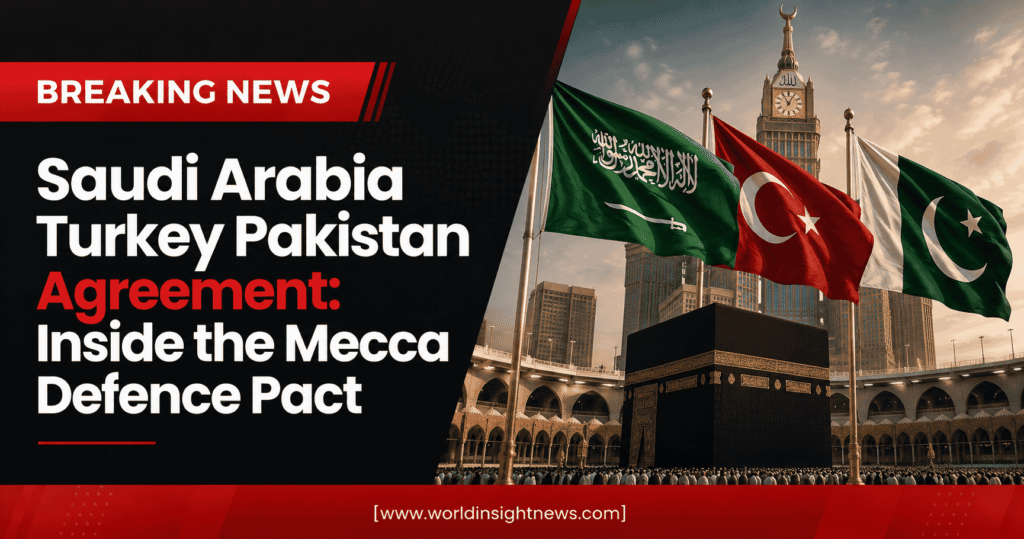
There is a particular kind of photograph that diplomats live for — the kind that ends up on the front page of every regional newspaper the next morning, endlessly dissected, endlessly reprinted. Last week, that photograph came out of al-Safa Palace in Mecca: Mohammed bin Salman in the centre, Recep Tayyip Erdogan on his left, Shehbaz Sharif on his right, each man holding a folder — two green, one crimson — containing the freshly inked pages of what is now being called the Mecca Joint Defence Agreement. Beneath the ceremony and the handshakes sits a document that may prove to be one of the more consequential pieces of Middle Eastern statecraft in years.
On its face, the arrangement is straightforward. Saudi Arabia, Turkey and Pakistan have agreed that an act of aggression against any one of them will be treated as an act of aggression against all three — a formulation that has, inevitably, drawn comparisons to Article 5 of the NATO charter. But treaties of this kind rarely announce their true significance in their opening clause. To understand what just happened in Mecca, it helps to look past the collective-security language and ask a more basic question: why these three countries, and why now.
A Pact Years in the Making
The agreement did not spring from nowhere. Its foundations were laid in September of last year, when Saudi Arabia and Pakistan quietly signed a bilateral Strategic Mutual Defence Agreement in Riyadh — a pact that, at the time, drew relatively modest international attention but that established the same core principle now expanded to include Ankara. By January, reports out of Turkey were already suggesting that Ankara was negotiating to fold itself into that arrangement, with officials citing growing unease in Turkish policy circles about the durability of America’s security commitments, both to Gulf partners and to NATO itself. What looked in January like a plausible rumour has, seven months later, become policy.
That sequencing matters. This was not a hastily assembled response to a single crisis, but the product of nearly a year of quiet negotiation, layered on top of defence relationships that go back decades. Pakistan has trained and advised Gulf militaries, including Saudi Arabia’s, since long before any of the current principals were in office. Turkey and Pakistan have exchanged warships and training aircraft for years. And in 2023, Riyadh signed what Ankara described as its largest defence-export contract to date, buying Turkish-made drones that have since become a familiar sight in Gulf skies. The Mecca agreement, in other words, formalises a set of relationships that were already thickening — it does not invent them.
The Shadow of Iran
None of this can be separated from the war that has been unfolding around Iran. Saudi Arabia’s oil infrastructure and its ambitious domestic development agenda have both been placed under strain by a conflict that, earlier this year, brought missile and drone strikes uncomfortably close to Saudi soil. That experience appears to have sharpened Riyadh’s calculus about the reliability of its longstanding American security guarantee — a guarantee that has underpinned Gulf security architecture since the 1940s but that now looks, to Saudi planners at least, less certain than it once did.
Turkey and Pakistan, for their part, have both worked hard to avoid being drawn directly into the Iran conflict. Neither has suffered significant attacks; neither has wanted to. Yet by binding themselves to Saudi Arabia’s defence, both have arguably accepted a form of exposure to exactly the conflict they had been trying to keep at a distance. This is the paradox sitting at the centre of the Mecca agreement: a pact designed to deter future aggression may, in the near term, tie two relatively insulated powers to the fate of a third that is very much in the line of fire.
Saudi officials have been careful to frame the agreement defensively rather than provocatively. Rayed Krimly, the kingdom’s deputy minister for public diplomacy, has insisted the pact poses no threat to any state in the region and exists purely to strengthen collective deterrence. Whether Tehran — or Washington, for that matter — reads it the same way is a separate question entirely.
Three Powers, Three Currencies
Part of what makes this alliance unusual is how differently each member measures its own contribution. Saudi Arabia brings capital and, by extension, influence — it remains the world’s largest oil exporter and the financial centre of gravity for much of the Islamic world. Pakistan brings something no other Muslim-majority state can offer: a functioning nuclear arsenal, along with a large, battle-tested military that has spent decades training and advising Gulf forces. Turkey brings NATO’s second-largest standing army and a defence-industrial base that has grown remarkably quickly, most visibly in drone technology that has already reshaped several conflicts well beyond Turkey’s borders.
Regional analysts, however, caution against assuming these contributions are weighted equally in the minds of the men who signed the agreement. Some Gulf-watchers argue that Riyadh’s interest in Pakistan’s nuclear status has long been overstated in Western commentary — useful as a talking point, perhaps, but not necessarily the decisive factor in Saudi thinking. What genuinely seems to interest Riyadh, according to several analysts who have studied the negotiations, is Turkey’s defence-manufacturing capacity: the prospect of transferring know-how and production capability into the Kingdom’s own nascent defence industry, part of the broader economic diversification agenda Saudi Arabia has been pursuing for the better part of a decade.
Ankara, meanwhile, appears to be extracting something closer to strategic reassurance. Turkish foreign-policy scholars have described the pact as a source of “strategic depth” for Turkey — a hedge against uncertainty in its NATO relationship and an opportunity to entrench itself as an indispensable security partner across a region where its economic and industrial footprint has been expanding for years regardless of formal alliances.
Not Quite NATO — At Least Not Yet
It is tempting, and not entirely inaccurate, to describe the Mecca agreement as a Middle Eastern answer to NATO. The mutual-defence language invites the comparison, and headline writers everywhere have obliged. But several regional-security specialists have pushed back on taking that analogy too literally, at least for now. The more accurate description, they argue, is that this is a framework for closer strategic, military and defence-industrial coordination among three influential regional powers — a foundation for deeper integration, rather than a fully realised collective-security architecture with the institutional machinery, joint command structures and decades of interoperability that give NATO its teeth.
That distinction matters for anyone trying to game out what happens if the pact is actually tested. Declarations of mutual defence are one thing; the operational reality of three militaries with different equipment, doctrine and command cultures coordinating under fire is another matter entirely. Whether the Mecca agreement evolves toward genuine interoperability, or remains largely a political signal, will likely become clearer only if — or when — it faces its first real test.
What Comes Next
The most interesting question raised by this agreement may not be about its text at all, but about its gravitational pull. Several analysts following the negotiations have speculated that the Mecca pact could mark the beginning of something larger — an emerging bloc of regional powers positioning themselves cautiously between Israel and Iran, wary of entanglement with either, while consolidating enough combined military and economic weight to matter on their own terms. If that reading holds, the three signatories in Mecca may end up being remembered less as the parties to a single defence treaty and more as the founding members of a new axis in a region that has rarely gone more than a decade without one.
For now, though, the agreement remains what it is: three governments, with three very different sets of interests and vulnerabilities, betting that formal solidarity is worth more than the risks that come with it. Whether that bet pays off will depend less on the language signed in Mecca than on decisions being made, at this very moment, in Tehran, in Washington, and in the war rooms of a conflict none of the three signatories chose but all of them now have a stake in.
This article draws on reporting and analysis from Al Jazeera, Reuters, CNN, and The Washington Post, published between January and August 2026.