
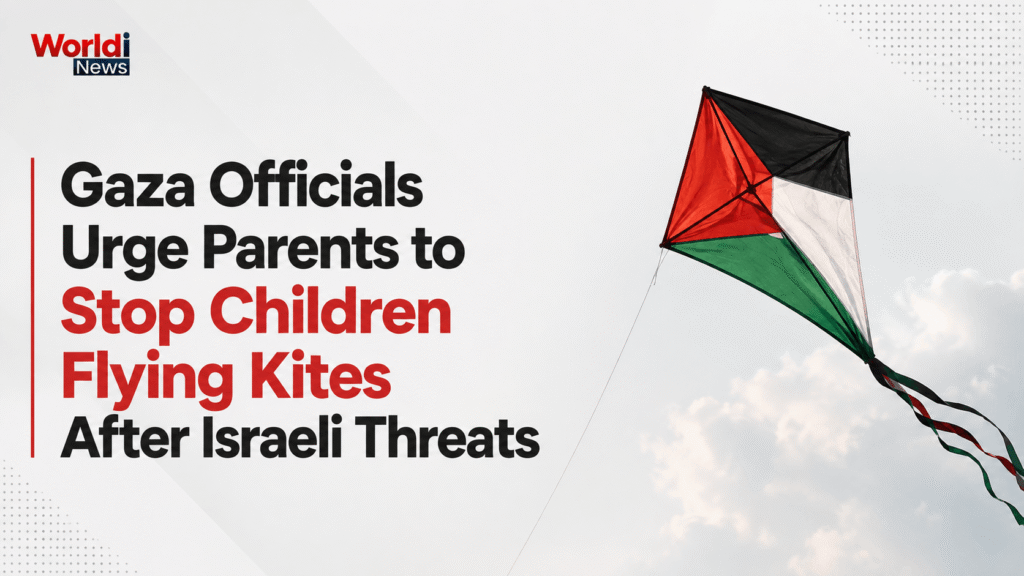
Gaza Officials Urge Parents to Stop Children Flying Kites After Israeli Threats
By World Insight News Desk— Aug. 26, 2026
Community groups running displacement camps in Gaza have urged parents to stop their children flying kites, after Israel warned it would strike those responsible and evacuate the areas the kites come from.
The appeal came in a statement issued late Monday by Gaza’s “popular committees,” a coordinating body of local non-governmental organizations and charities that operate the enclave’s camps and shelters. A source in Hamas said the announcement was coordinated with the group’s authorities. The committees said their goal was not to curtail children’s play but to keep them safe, adding they were working to end the practice “to protect their innocent lives.”
The warning follows reports that several kites, none found to be carrying incendiary material, drifted from Gaza into Israel over the past month, including at least four that landed in the Nahal Oz kibbutz near the border over the weekend. The Israeli military said it examined the kites and found nothing suspicious.
Prime Minister Benjamin Netanyahu and Defense Minister Israel Katz said in a joint statement Sunday that unless the launches stop immediately, the military would intensify strikes on those it holds responsible and order the evacuation of populations from areas where kites, drones or balloons are launched. Katz separately said he had directed the army to respond “immediately and forcefully” and described any launch, regardless of whether it carried explosives, as equivalent to a drone strike.
Israeli warning met with a call for calm in Gaza
Israeli officials have cast the recent kites as a potential revival of a tactic used during 2018 protests along the Gaza border, when incendiary kites and balloons carrying burning material started fires on Israeli farmland. Palestinian officials and analysts have rejected the comparison, saying the current kites carry no incendiary payload and are flown by children in displacement camps as recreation.
Hamas spokesman Hazem Qassem dismissed the Israeli characterization, describing the objects as children’s toys. A member of Hamas’s political bureau, Basem Naim, went further, accusing Israel of recasting an ordinary children’s activity as a military threat while continuing its own strikes on Gaza despite the ceasefire in place since October 2025. The Israeli military has not disclosed what evidence, if any, led it to link the recent kites to an organized campaign.
Gaza residents said they took the Israeli threat seriously regardless of the kites’ contents. Umm Mohammed, a mother in Gaza City, said her 10-year-old son and other children in her street fly kites every summer to pass the time, but that she would no longer allow it. Marwan Al Harazeen, 55, a resident of Deir al-Balah who was displaced from northern Gaza, said children in his area fly kites regularly and that parents should now stop them, given Israel’s readiness to use any pretext to strike.
A Palestinian political analyst, Mkhaimar Abusada, said the kites bore little resemblance to the incendiary devices of 2018 and suggested Netanyahu could be using the issue for domestic political purposes ahead of Israeli elections, after falling short of his stated goal of eliminating Hamas. He said the matter could be defused at the community level if families kept children from flying kites, adding that Palestinians in Gaza could not withstand a fresh escalation triggered by a child’s kite.
Background
Gaza’s kite-flying tradition became militarized in 2018, when Palestinian demonstrators taking part in the “Great March of Return” protests along the border launched kites and helium balloons carrying burning rags and coals into Israel. The devices, along with balloons carrying Molotov cocktails, set fire to what Israeli and international estimates put at several thousand acres of farmland and nature reserves near the Gaza boundary over the following months. Similar incendiary launches recurred intermittently until 2021.
The current warnings come seven months into a ceasefire that took effect on Oct. 10, 2025, ending a war that began after Hamas-led fighters attacked southern Israel on Oct. 7, 2023, killing about 1,200 people and taking 251 hostages. Gaza’s Health Ministry has said more than 73,000 Palestinians were killed over the course of the war; Israel has disputed aspects of the ministry’s methodology but a senior Israeli military official said in January that the army accepted a toll of roughly 70,000. The ministry, whose figures are widely regarded by international bodies as broadly reliable though it does not distinguish combatants from civilians, has also recorded more than 1,280 Palestinians killed by Israeli fire since the truce began, with both Israel and Hamas accusing each other of violations.
What follows
The dispute has drawn in international bodies overseeing the truce. An official with the U.S.-led committee monitoring the ceasefire, known as the Board of Peace, said all militant activity in Gaza, including kite flying, must stop and that the message had been conveyed to Hamas through established channels, while also stating that Israeli military action must be limited to responses to genuine, imminent threats. On Tuesday, a spokeswoman for the U.N. human rights office, Ravina Shamdasani, said the threat to expel residents over children flying kites was “outrageous.”
It remains unconfirmed whether any of the recent kites carried explosive or incendiary material, and Israel has not detailed what prompted its officials to draw a parallel to the 2018 campaign. Whether the popular committees’ appeal will be enough to prevent further kites from crossing the border, and whether Israel will follow through on its threat of strikes or evacuations, had not been determined at the time of publication.
Sources
Facts in this article are drawn primarily from Reuters wire reporting on the popular committees’ statement, corroborated by The Times of Israel, Al Jazeera and The National on the Israeli military response, casualty figures and reaction from officials and residents.
Wire services and international press
- Reuters (via Arab News), “Gaza parents urged to stop kids flying kites after Israel warning to Hamas.” https://english.aawsat.com/arab-world/5310874-gaza-parents-urged-stop-kids-flying-kites-after-israel-warning-hamas
- Al Jazeera, “UN rejects Israel’s threat to expel Gaza residents over kite-flying.” https://www.aljazeera.com/news/2026/8/26/un-rejects-israels-threat-to-expel-gaza-residents-over-kite-flying
- The Times of Israel, “IDF told to act forcefully against Gaza kites; 3 reported killed in Israeli strikes.” https://www.timesofisrael.com/idf-told-to-act-forcefully-against-gaza-kites-one-reported-killed-in-israeli-airstrike/
- The Times of Israel, “In rare warning, Board of Peace tells Israel to limit Gaza fire to ‘genuine’ threats.” https://www.timesofisrael.com/in-rare-warning-board-of-peace-tells-israel-to-limit-gaza-fire-to-genuine-threats/
Local and regional press (context and named sources)
- The National, “Gaza’s children grew up flying kites. Now Israel says they will be treated as drones.” https://www.thenationalnews.com/news/mena/2026/08/25/gazas-children-grew-up-flying-kites-now-israel-says-they-will-be-treated-as-drones/
- Arab News, “How Gaza’s kite tradition became entangled in conflict.” https://www.arabnews.com/node/2655710/middle-east
- Al Jazeera, “Israel kills 3 in Gaza as Netanyahu threatens attacks over kite launches.” https://www.aljazeera.com/news/2026/8/23/israeli-air-strike-near-gaza-refugee-camp-kills-one-person-and-injures-two
Background and casualty data
- Al Jazeera, “How many times has Israel violated the Gaza ceasefire? Here are the numbers.” https://www.aljazeera.com/news/2025/11/11/how-many-times-has-israel-violated-the-gaza-ceasefire-here-are-the-numbers
- Al Jazeera, “Israeli strikes hit water plant, warehouse in Gaza, killing at least seven.” https://www.aljazeera.com/news/2026/8/24/israeli-strike-on-gaza-shelter-extends-casualty-list
- The Jewish Chronicle, “Kites from Gaza found in Israel spark memory of 2018 arson attacks.” https://www.thejc.com/news/israel/kites-from-gaza-found-in-israel-spark-memory-of-2018-arson-attacks-ih5mvqdm
- Gulf News, “Death toll from Gaza war surpasses 70,000: Health ministry.” https://gulfnews.com/world/mena/death-toll-from-gaza-war-surpasses-70000-health-ministry-1.500364057
Editor’s note on sourcing An Israeli defense-official claim, reported by only one outlet, that Hamas was deliberately encouraging Gazans to fly kites to provoke Israel was excluded for insufficient corroboration. Casualty and ceasefire-violation figures vary slightly by outlet and date because they update daily; this article uses the most recent Gaza Health Ministry figures as reported by Al Jazeera on Aug. 24–26, 2026. Netanyahu’s stated rationale linking the kites to a broader drone threat, reported by The Times of Israel, is attributed to him rather than presented as established fact. It remains unconfirmed whether any of the recent kites carried incendiary material.