
Australia to bar most international students from bringing family members
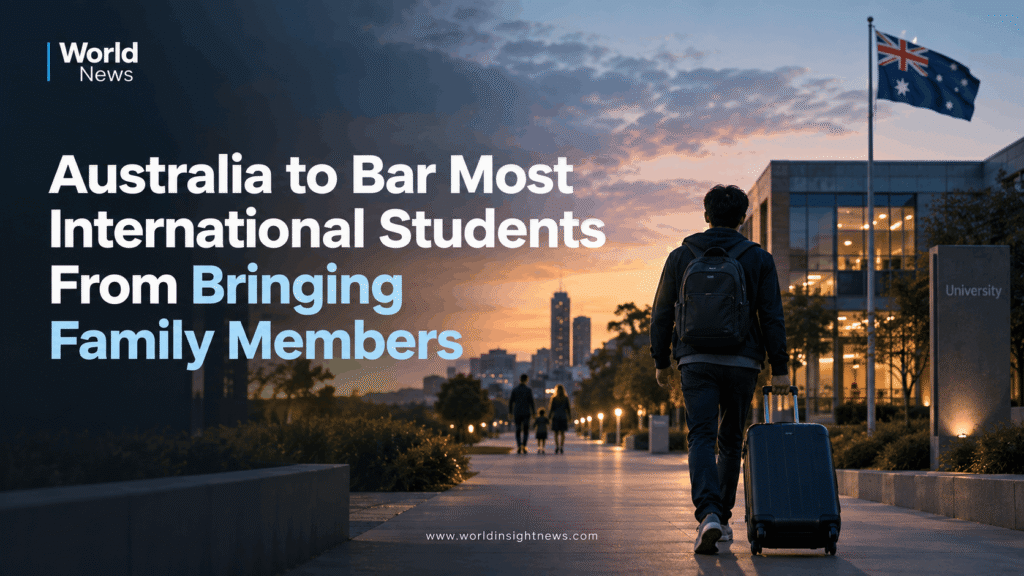
Australia will stop most new international students from bringing a partner or children with them, under a package of immigration changes announced Thursday as the government tries to bring migration down to levels set out in its budget.
Home Affairs Minister Tony Burke announced the changes in a speech to the National Press Club in Canberra. He said international student numbers themselves would not be cut, but most students would no longer be able to add a partner or child to their visa as a secondary applicant. The restriction applies only to future visa grants; students already in Australia with family members on their visa will not be affected, and no start date has been set, since the change is being made by regulation rather than legislation.
Exemptions will apply to students from Pacific and Southeast Asian nations under existing bilateral arrangements, and to students undertaking a PhD.
Overseas arrivals target
Burke said the government now treats its forecast of 245,000 net overseas migration this financial year, falling to 225,000 a year from 2026-27 onward, as a target it intends to meet, citing pressure on housing supply. Net overseas migration was 292,100 in the year to March, according to Australian Bureau of Statistics figures released hours before the speech, down from about 299,000 the previous year.
Burke rejected description of Australia as a country of “mass migration,” saying the population was on track to be 700,000 lower by 2030-31 than pre-pandemic forecasts had projected. He said cutting migration further, as opposition parties have proposed, would hurt the economy, and that immigration was not the underlying cause of the housing shortage, though he said it needed to be “part of the solution.”
Other visa changes
Burke also announced changes to the Working Holiday Maker, or backpacker, program. Processing of second- and third-year visa applications, which had slowed for months, will speed up again for nationalities whose schemes require regional work, though a new ballot will cap places: 45,000 for a second year, down from about 57,000 who qualified last year, and 5,000 for a third year, down from about 31,000. Applicants for a second year will still need 88 days of regional work, and third-year applicants six months. British backpackers, who do not have a regional work requirement under the UK-Australia free trade agreement, are not covered by the faster processing; their numbers have grown from about 17,000 before the pandemic to nearly 80,000 now.
International students who switch courses will need to apply for a new visa, and graduates will only be able to move into a higher-level qualification — a bachelor’s graduate could move to a master’s degree, for instance, but not laterally between courses. Burke described this as targeting “visa hopping” by people using course transfers to prolong their stay.
Visitor visas will generally carry a “no further stay” condition, intended to stop people arriving as visitors and then applying onshore for other visas. The government will also fund 100 additional compliance officers and 250 new immigration detention beds, and is examining whether a former quarantine facility in Melbourne could be repurposed for detention. Burke said the code governing migration agents would be tightened so agents could be sanctioned or deregistered for encouraging clients to lodge weak claims.
Separately, the points test for skilled permanent visas will be redesigned to give trade qualifications, including in construction, the same weighting as a university degree. Burke also said Ministerial Direction 119, which since July had pushed offshore skilled visa applications to the back of the processing queue and blown out wait times to more than a year in some cases, would be changed to prioritise construction, healthcare, agriculture, fisheries and teaching applicants.
Burke said he would also like Parliament to legislate a mechanism letting the government control the number of new student arrivals directly, rather than simply processing applications as they come in, and separate changes to speed the rejection of weak asylum claims. He said the government did not currently have a path to pass such legislation and did not plan to introduce it without in-principle support, out of concern that flagging the changes in advance would prompt people to rush applications before they took effect.
Political backdrop
The announcement follows a rise in migration as a political issue. Earlier this week, the minor party One Nation proposed cutting net overseas migration into negative territory for three years before settling at 130,000 people annually, with cuts to family visas for both students and skilled migrants. The opposition Coalition has not yet released its own policy but has signalled a target in the range of 150,000 to 170,000, tied to the number of new homes built.
Burke said comparisons between the government’s approach and the Trump administration’s immigration enforcement in the United States were wrong, and that the changes had been under development before One Nation’s surge in recent polling, not in response to it.
Opposition and minor-party reaction was mixed. Deputy Liberal leader Jane Hume said the Coalition would assess the plan before releasing its own policy, and Liberal MP Zoe McKenzie said the changes amounted to a plan “to choke migration, not change migration.” Nationals leader Matt Canavan criticised the backpacker changes as unfair to farmers, and the National Farmers’ Federation warned the tighter working holiday rules would raise food prices and leave supermarket shelves emptier before Christmas. Greens senator David Shoebridge compared the increased detention and compliance measures to immigration enforcement under the Trump administration in the United States. Universities Australia, the sector’s peak body, said it was concerned the changes could cause lasting damage to the international education sector.
What follows
No date has been set for the family-visa restriction or most of the other regulatory changes to take effect. The legislative measures Burke flagged — a mechanism to directly control student arrival numbers, and faster rejection of weak protection claims — have not been introduced to Parliament, and the government has said it does not currently have the numbers to pass them.
Sources
International reporting on Thursday’s announcement is corroborated by ABC News’s live coverage and wrap-up of Tony Burke’s remarks, with the Reuters wire dispatch confirming the substance of the international student and backpacker changes as reported to a global audience.
Wire services and international press
- Reuters, “Australia cracks down on student and backpacker visas to curb migration.” (via NewsBreak syndication) https://www.newsbreak.com/reuters-555486/4890627515430-australia-cracks-down-on-student-and-backpacker-visas-to-curb-migration
Local press (proceedings and remarks)
- ABC News, “Labor tightens visa rules as Tony Burke vows migration targets will be met.” https://www.abc.net.au/news/2026-09-17/labor-immigration-crackdown-students-backpackers-overstay-visa/107164354
- ABC News, “Federal politics: Government’s migration policy unveiled by Tony Burke — as it happened.” https://www.abc.net.au/news/2026-09-17/federal-politics-live-blog-sept-17/107161304
- Neos Kosmos, “Labor to crack down on foreign students, family visas.” https://neoskosmos.com/en/2026/09/17/news/australia/labor-to-crack-down-on-foreign-students-family-visas/
Background and prior proceedings
- ABC News, “International students to be effectively barred from bringing family to Australia” (Sept. 16, 2026). https://www.abc.net.au/news/2026-09-16/federal-politics-tony-burke-bar-international-students-family/107160258
Editor’s note on sourcing Figures on visa numbers, ballot caps and net overseas migration are drawn from Burke’s National Press Club remarks as reported by ABC News, Australia’s national broadcaster, and corroborated in substance by the Reuters wire report. The precise implementation date for the family-visa restriction has not been announced by the government as of publication and is not stated here. Reaction quotes from opposition and crossbench figures are drawn solely from ABC’s live coverage; where a second outlet did not independently confirm a specific quote, it has been paraphrased rather than quoted directly.