Why JPMorgan Is Spending Big on the 2028 LA Olympics
Why JPMorgan Is Spending Big on the 2028 LA Olympics
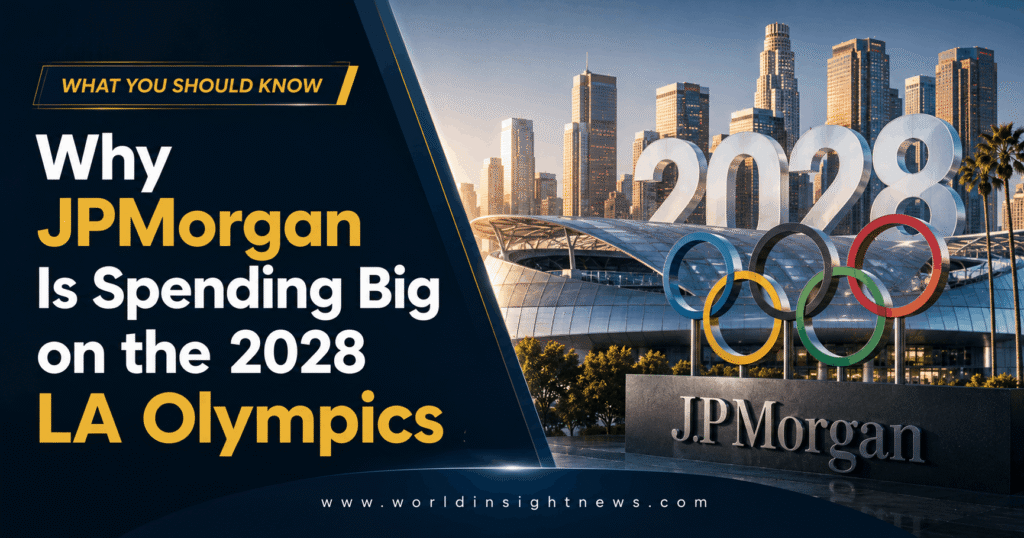
JPMorgan Chase has signed one of the biggest sponsorship deals in Olympic history. Most people saw the news and thought it was just another logo on a banner.
It isn’t. The bank is not really buying the two weeks of sport in July 2028. It is buying two years of access to Los Angeles businesses.
Here is what happened, and why the bank is doing it.
What the deal actually is
In April 2026, JPMorgan Chase became the first bank ever to join the Olympics’ top sponsor group. That group is called The Olympic Partners. It is the most expensive level there is.
The deal covers two events: the Los Angeles 2028 Summer Games and the 2030 Winter Games in the French Alps.
The bank also signed a separate deal with LA28, the group organising the Los Angeles Games. Under that deal, JPMorgan becomes:
- The official bank of Team USA
- The official bank of the LA28 Games
- A founding partner of LA28
Neither side said how much it cost. CNBC reported that deals at this level usually cost more than $200 million for a four-year cycle. John Slusher, who sells sponsorships for LA28 and Team USA, told CNBC that JPMorgan is about as big a partner as they ever get.
Reason 1: The bank is already huge in Los Angeles
This is the part most people miss.
JPMorgan says it already has about 5 million everyday banking customers in Los Angeles. It also has around 589,000 small business customers there.
So the bank is not trying to enter a new city. It is trying to grow where it is already strong.
That changes what the sponsorship is for. A new company would use the Olympics to become known. JPMorgan doesn’t need that. It needs a reason to talk to customers it already has, and a reason for new ones to pick up the phone.
Reason 2: An Olympics means two years of new business
Before any Games, a huge amount of money gets spent. Caterers, security firms, transport companies, hotels, builders and equipment suppliers all get contracts. Almost all of them need loans and bank accounts to handle that work.
JPMorgan wants to be the bank they use.
That is why it announced a hiring plan alongside the sponsorship:
- More than 100 new business bankers across Southern California over the next five years — about a 30% increase
- Training for more than 3,700 extra small business owners in Greater Los Angeles and Riverside
- Over $1 million in new community funding, on top of more than $15 million since 2020
- A new community branch in East LA, its 20th in the country
Carla Hassan, the bank’s chief marketing officer, told CNBC this is a company-wide project. She said the goal is to bring support to small businesses so they can benefit from the money the Olympics brings in.
Notice the timeline. The hiring runs for five years. The Games last about two weeks. The sport is not the point.
Reason 3: Nobody had taken the banking spot
For 40 years, the Olympics sold its top sponsor slots to almost every industry. Coca-Cola has drinks. Visa has been the card partner since 1986. Cars, insurance, watches, phones — all taken.
Banking was never sold to anyone.
So the Olympics created a new slot instead of moving an old one. JPMorgan got wealth management, private banking and investment banking worldwide. It got retail banking only in the United States. Visa keeps payments.
That means JPMorgan gets a category no rival can copy, and nobody had to lose anything for it to happen.
Reason 4: It was a good time to negotiate
At the end of 2024, three big sponsors left the Olympics’ top group: Panasonic, Toyota and Bridgestone. That was bad news for the Olympics and good news for anyone wanting to buy in.
Slusher has been rebuilding the sales side since then. The main change is that LA28, Team USA and the Paralympic rights are now sold together as one package. A company signs one deal instead of three.
Organisers are also creating new things to sell, including a 100-day torch relay across all 50 states and naming rights for venues.
Slusher has admitted the balance is tricky. They need the money to run a better Games, but they can’t turn the Olympics into one long advert.
For a buyer with cash, that situation is leverage. JPMorgan negotiated at a moment when the Olympics needed sponsors more than sponsors needed the Olympics.
What could go wrong
A few things.
The results are hard to measure. Hassan said the bank will judge success on brand strength, customer engagement, new customers and staff pride. Two of those are countable. Two are not. Companies often lean on soft measures when they can’t prove the money came back.
The Games could go badly. LA28 has a budget of around $7.15 billion. It has raised about $2.2 billion of its $2.5 billion sponsorship target, which is ahead of where Paris was. No public money has been used so far. But the city of Los Angeles has agreed to cover the first $270 million of any overspend, and the state covers more after that. If costs blow up or the Games are badly run, founding partners are in the photo too.
Rivals will fight back. Every other bank in Los Angeles now has two years to advertise against JPMorgan’s Olympic rings. That happens at every Games.
The simple version
Jamie Dimon, JPMorgan’s CEO, said Olympic athletes are also customers, clients and staff, and that the bank finances the communities and facilities behind them.
That is a sponsorship explained in the language of lending, not marketing. Which tells you what this really is.
The rings get JPMorgan in the door. The branches and the bankers are what it is actually selling. It is paying for a reason to be everywhere in Southern California until 2028, and for customers it hopes to still have in 2033.
Whether it works won’t show up in an advertising report. It will show up in the loan book.