Iran Begins Public Mourning for Ayatollah Ali Khamenei, Killed in February
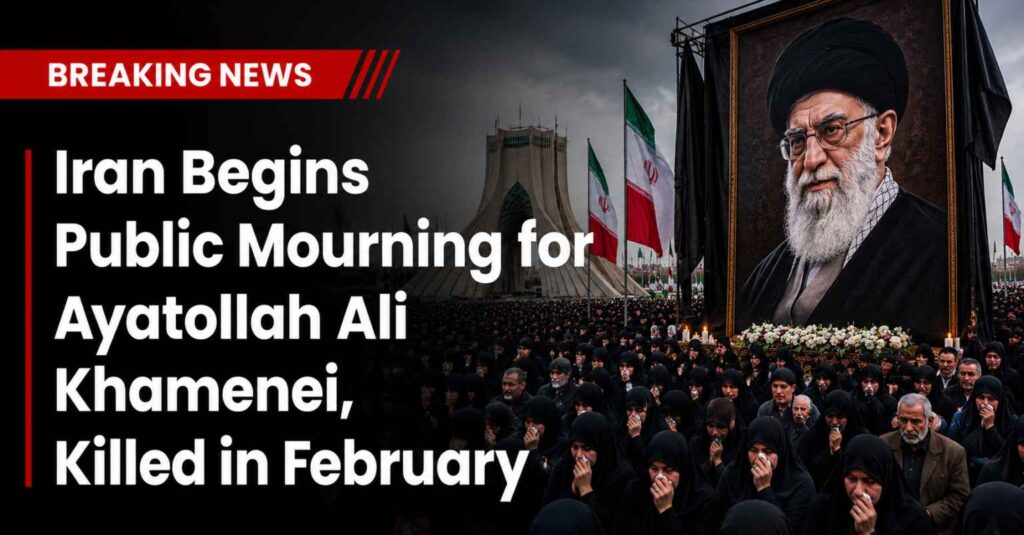
More than four months after his death, Iran has opened a week of mass public mourning for Supreme Leader Ayatollah Ali Khamenei, whose body now lies in state in the capital ahead of what officials say will be the largest funeral in the country’s history.
The ceremonies, which formally began this week, mark the emotional climax of one of the most turbulent chapters in the Islamic Republic’s four-decade history — the assassination of the man who had led Iran since 1989.
What Happened in February
Khamenei was killed on February 28, 2026, in Tehran, in a series of Israeli airstrikes that targeted senior Iranian officials during the 2026 Iran war. His death was confirmed by the Iranian government on March 1. He was one of the highest-ranking figures killed in that campaign, and his assassination sent immediate shockwaves through the region and global markets.
In the days that followed, the government declared 40 days of official mourning and announced a seven-day national holiday. But the reaction inside Iran was not uniform. Supporters gathered to grieve — footage from near the Imam Reza shrine in Mashhad showed mourners weeping and collapsing in grief — while in parts of Tehran, cheers and celebrations were reported after news of his death spread. That split reaction underscored the deep divisions that have run through Iranian society for years.
Why the Funeral Was Delayed Until July
The state funeral was originally scheduled for March 4–6 across Tehran and Mashhad. It was postponed because of the ongoing war, which made large public gatherings impossible and left the country focused on the conflict rather than ceremony.
With conditions now allowing mass assembly, authorities set the funeral rites for July 4–9, staging them across several of the country’s most symbolically important cities. The timing is significant in its own right: the ceremonies fall during Muharram, the Islamic month most closely associated in Shiite tradition with mourning, sacrifice, and the seventh-century martyrdom of Imam Hussein — a resonance the government has leaned into heavily.
The Scenes This Week
Khamenei’s body is on display at Tehran’s Grand Mosalla on Saturday and Sunday, where dignitaries and mourners have gathered to pay tribute. His casket has been draped in the sacred red flag that once flew over the shrine of Imam Hussein — described by the Iranian government as a symbol of resistance, sacrifice, and devotion to truth.
The processions ahead are elaborate. On Monday, the casket is to be paraded through the streets of Tehran before being carried roughly 120 kilometers south to Qom, the seminary city at the heart of Shiite scholarship in Iran. Later in the week, his body is to be taken to Karbala in Iraq — home to the shrine of Imam Hussein — before final burial in Mashhad at the Imam Reza shrine, one of the holiest sites in Shiite Islam.
A Funeral on a Historic Scale
Iranian officials say they expect between 15 and 20 million mourners to take part over the course of the week — a figure that, if realized, would make it the largest state funeral the country has ever held. Authorities have prepared for participants arriving from across the region.
The scale is not only about grief. Coming after months of war, the funeral is also a political statement. State messaging has framed the enormous turnout as a show of national unity and defiance toward Iran’s adversaries, and foreign envoys are attending. In effect, the ceremonies serve a dual purpose: honoring the late leader while projecting resilience at a moment of profound uncertainty for the Islamic Republic.
What Comes Next
Khamenei’s death leaves an extraordinary vacuum. As supreme leader, he held ultimate authority over Iran’s armed forces, judiciary, and major state institutions for more than three decades. The question of succession — and how a post-Khamenei Iran will navigate its relationships at home and abroad — now looms over everything happening in the streets this week.
For now, though, the focus is on mourning. After a delay of more than four months, Iran is finally staging the farewell it had planned, on a scale intended to be remembered for generations.
This article is based on reporting from CNN, NPR, Euronews, Haaretz, ABC News, France 24, and Wikipedia. Details of the funeral schedule and mourner estimates are drawn from statements by Iranian officials and may be updated as the ceremonies proceed.