Nepal flood death toll rises to 734 as nearly 2,500 remain missing
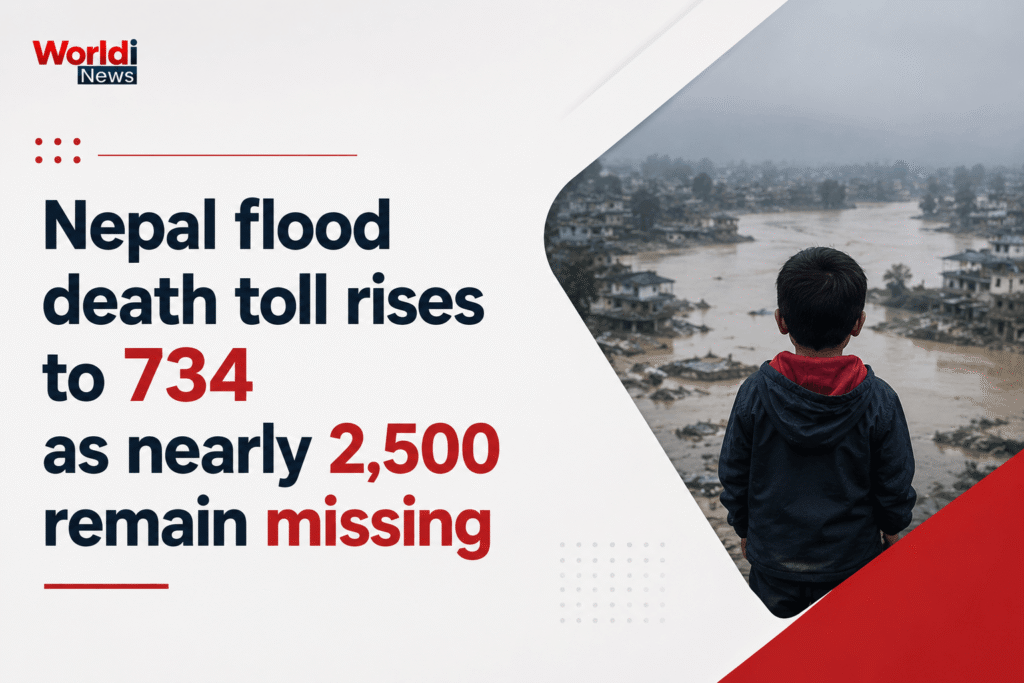
The death toll from flash floods and mudslides that struck Nepal’s northern border with China rose to at least 734 on Sunday, with nearly 2,500 people still missing, as rescue teams entered a fifth day of searching devastated river valleys.
Nepal’s National Disaster Risk Reduction and Management Authority, the government agency coordinating the response, put the number of missing in the country at 2,498, up from 2,426 a day earlier. Of those, 589 are foreign nationals, the authority said, including roughly 100 Americans. More than 8,100 people have been rescued so far. Separately, Chinese state media reported 16 deaths and 546 people missing in Tibet’s Gyirong County, on the other side of the border, bringing the combined toll to 750 dead and more than 3,000 missing.
The disaster struck a 45-mile stretch of the Trishuli River and its tributaries on the morning of Aug. 26, tearing through settlements in Nepal’s Rasuwa, Nuwakot, Dhading, Gorkha, Tanahun, Nawalparasi and Chitwan districts. It destroyed the Gyirong Port complex, a major trade and tourism crossing between Nepal and China, and swept debris as far as 150 miles downstream into India, where authorities said they had recovered seven bodies believed to be flood victims. The Nepal Red Cross said more than 90,000 people had been affected.
Rescuers have been hampered by damaged roads, power outages and fears of further flooding along the border region. Nepal’s disaster authority said the road linking Kathmandu to Dhunche, in Rasuwa, has reopened to light vehicles, easing access to some of the worst-hit areas. A priority for search teams is a group of workers believed trapped in tunnels at the Upper Trishuli and Rasuwagadhi hydropower projects; Nepal’s energy minister, Biraj Bhakta Shrestha, called their rescue the highest priority for authorities. Engineers involved in the operation have cautioned that tunnels may be filled with mud or water and that emergency shutdown systems may have failed, raising the risk that rescuers could encounter flooded turbine rooms.
What triggered the flood
Nepali officials and scientists say the flood was set off by a large-scale collapse of ice, rock and debris from the northern face of Langtang Lirung, a peak on the Nepal-Tibet border, though the precise mechanism has not been confirmed. Satellite imagery examined by Nepali researchers shows a mass of glacier ice and rock falling roughly 2,000 meters down the mountainside before slamming into the Lhende Khola, a tributary that feeds the Trishuli River. Researchers say the impact likely generated enough energy to rapidly melt snow and ice, adding to the volume of water that surged downstream. The event registered as a magnitude-5.2 tremor detected by seismometers worldwide, according to the U.S. Geological Survey.
Scientists caution that a full determination — including whether a glacial lake outburst played a role — will require further satellite analysis and, once conditions allow, a field investigation. Nepal’s foreign minister, Shisir Khanal, initially said an earthquake had triggered an avalanche that caused the flooding; other officials and outside researchers have since described it as an ice-rock collapse rather than a seismic event in its own right. Climate scientists say the collapse fits a broader pattern of instability in Himalayan glaciers, which they say have lost mass at a faster rate since 2000, though researchers caution that establishing a direct link between climate change and this specific event will take further study.
Toll still climbing, thousands unaccounted for
The gap between the confirmed dead and the missing has stoked anxiety among families still waiting for word of relatives five days after the disaster. Nepal’s disaster authority said 933 of those unaccounted for in its Saturday count were workers employed on hydropower projects along the river. The Nepal Tourism Board said 261 foreign nationals have been rescued so far, and it remains unclear how much overlap exists between Nepal’s and China’s separate tallies of missing people, since some may have crossed the border area at the time of the disaster.
The U.S. State Department said it was providing $3.6 million in humanitarian assistance, including emergency food aid for up to 10,000 flood-affected households, and said it was in contact with American citizens in the region through its embassy and a dedicated hotline. India and China have sent tunnel-rescue and forensic specialists to Nepal at the government’s request, and South Korean experts have also been permitted to inspect affected sites, according to the Kathmandu Post.
Government response
Nepal’s Council of Ministers has declared the affected region a disaster zone for three months under the country’s disaster management law, a designation that unlocks emergency funding and coordination powers. Prime Minister Balendra “Balen” Shah said more than 15,000 security personnel — drawn from the Nepali Army, Nepal Police and Armed Police Force — have been deployed for search and rescue, along with 16 helicopters. Shah and his Council of Ministers have pledged to donate a month’s salary to the government’s disaster relief fund, and the Finance Ministry has been directed to prepare a relief and concessional-financing package for affected households and businesses. The government has offered free medical treatment to the injured and financial assistance to bereaved families, and has asked donors to use only its official channels after fake fundraising appeals began circulating online.
Background
The slope above the Lhende Khola has produced deadly flooding before. A debris avalanche on Langtang Lirung triggered by Nepal’s 2015 earthquakes destroyed nearby villages and killed more than 350 people, and a smaller flood from the same general area in July 2025 forced evacuations and destroyed a border bridge, though it caused no reported deaths on that occasion. Researchers who study the Langtang glaciers have found the ice there is retreating at an accelerating pace, a trend they link to regional warming.
What follows
A lake formed by the initial landslide has begun overflowing, according to reporting from the affected region, raising the risk of further flooding downstream even as search operations continue. Authorities have not yet said when they expect to complete recovery efforts or when the number of missing might stabilize. The final death toll, the precise geological trigger and the extent of overlap between Nepal’s and China’s missing-person counts remain unconfirmed.
Sources
Casualty figures, rescue totals and U.S. assistance figures are attributed to Nepal’s disaster authority, Chinese state media and the U.S. State Department as reported by wire and broadcast outlets below. Scientific explanations of the flood’s cause are attributed to named researchers as quoted in Nepali and international outlets.
Wire services and international press
- NBC News, “Nepal flood death toll rises to 734 as nearly 2,500 remain missing.” https://www.nbcnews.com/world/asia/nepal-floods-death-toll-climbs-missing-rescue-efforts-rcna594990
- ABC News, “Nepal-Tibet flood death toll rises to 750, officials say, more than 3,000 missing.” https://abcnews.com/International/nepal-tibet-flood-death-toll-rises-750-officials/story?id=136067514
- CNN, “August 29, 2026 — Death toll rises, thousands missing in Nepal-China floods.” https://www.cnn.com/2026/08/29/world/live-news/nepal-china-flood
- CNN, “Live updates: Rescuers search for missing workers as death toll rises from devastating China-Nepal floods.” https://www.cnn.com/2026/08/30/world/live-news/nepal-china-flood
- Free Malaysia Today, “Nepal flood death toll rises to 734.” https://www.freemalaysiatoday.com/category/world/2026/08/30/nepal-flood-death-toll-rises-to-734
- Forbes, “Nepal Flash Flood: Experts Say Climate Change Primed Disaster.” https://www.forbes.com/sites/davidrvetter/2026/08/27/nepal-flash-flood-experts-say-climate-change-primed-disaster/
- EarthSky, “Nepal flash flood nightmare: What caused it?” https://earthsky.org/earth/nepal-flash-flood-glacier-collapse-landslide-aug-26-2026/
Local press (proceedings and official statements)
- The Kathmandu Post (via OnlineKhabar English News), “‘Rasuwa flood may have been triggered by a massive ice-rock fall, not a glacial lake outburst.'” https://english.onlinekhabar.com/flood-trigger-langtang-rockfall.html
- Khabarhub, “Rasuwa flood: 13,295 security personnel mobilized for search and rescue; 1,976 people rescued.” https://english.khabarhub.com/2026/28/565289/
- Ratopati, “Prime Minister Balen Shah Reviews Flood Relief Efforts.” https://english.ratopati.com/story/76936/the-state-will-reach-out-to-every-citizen-waiting-for-rescue-prime-minister-shah
- The Tribune (India, syndicated ANI report), “Over 4,400 rescued, 15,000 security personnel deployed as Nepal mobilises massive flood relief Op: PM Balen Shah.” https://www.tribuneindia.com/news/armed-police-force/over-4400-rescued15000-security-personnel-deployed-as-nepal-mobilises-massive-flood-relief-op-pm-balen-shah
Background and prior events
- 2026 Nepal floods, Wikipedia (compiling Kathmandu Post and other primary reporting). https://en.wikipedia.org/wiki/2026_Nepal_floods
- Kathmandu Post, “Seven confirmed dead in Rasuwa flood” (Aug. 26, 2026). https://kathmandupost.com/national/2026/08/26/seven-confirmed-dead-in-rasuwa-flood
- News on Air, “Nepal: 9 rescued in Rasuwa as Lhende stream floods; 15 still missing” (July 2025, on the smaller precursor flood). https://www.newsonair.gov.in/nepal-9-rescued-in-rasuwa-as-lhende-stream-floods-15-still-missing
Editor’s note on sourcing A separate live-updates tracker reported a higher Sunday-evening figure of 781 dead and 2,502 missing, attributed to a later NDRRMA situation report, but that figure was not corroborated by any of the wire services or the Kathmandu Post at time of writing and has been excluded; this article uses the 734/2,498 figures reported by NBC News, ABC News and Nepal’s disaster authority as of Sunday, since those were consistent across multiple independent outlets. The claim that a barrier lake formed by the landslide has begun overflowing comes from a single outlet and is noted as unconfirmed rather than stated as fact. The reporter byline is used for house style and does not represent an actual correspondent.