Is the Deep State Real? The History Behind America’s Secret Power
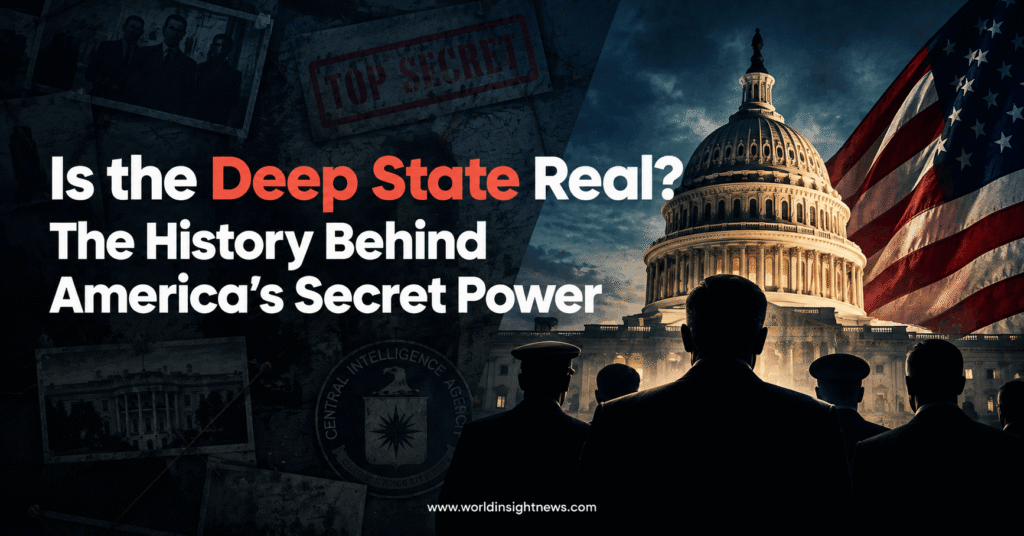
The phrase “deep state” has become one of the most politically charged terms in the United States. For some, it describes a hidden network of unelected officials working behind the scenes. For others, it has become a political slogan used to describe almost anything they oppose.
But the idea did not simply appear in modern American politics.
To understand why the idea of a deep state exists, it is necessary to look at the history of America’s intelligence agencies, the enormous power they accumulated, and the controversies that followed.
From World War II to the CIA
Before World War II, American intelligence agencies were largely viewed as wartime institutions. During a war, the government created intelligence operations to gather information and conduct secret missions. When the war ended, the expectation was that these organizations would be reduced or dissolved.
That changed dramatically after the bombing of Pearl Harbor.
President Franklin Roosevelt turned to William “Wild Bill” Donovan, a Wall Street lawyer and intelligence advocate. Donovan became the head of the Office of Strategic Services, or OSS.
The OSS was given enormous freedom to conduct operations during the war. Its activities included espionage, propaganda, sabotage, psychological operations and other secret missions.
The organization became the foundation of America’s modern intelligence system.
But when World War II ended in 1945, President Harry Truman faced a difficult question: what should happen to an organization that had been created to operate in wartime?
Truman was concerned about concentrating too much secret power in the hands of unelected officials. He did not want the United States to create what he described as an “American Gestapo.”
The OSS was eventually dissolved.
But the story did not end there.
The Birth of the CIA
The end of World War II quickly gave way to another global confrontation.
The United States and the Soviet Union became rivals, and the Cold War began.
Supporters of a permanent intelligence agency argued that America needed a centralized organization capable of dealing with the Soviet Union and the new global threat.
Critics warned that giving a secret organization enormous power could threaten democratic institutions and civil liberties.
Eventually, the United States created the Central Intelligence Agency.
The CIA was officially given the responsibility of gathering and distributing intelligence related to national security. But its legal language also included broad provisions allowing it to perform other functions related to intelligence.
That broad mandate became important.
Over the following decades, the CIA became involved in operations around the world.
Secret Operations and Controversies
The history of the CIA includes numerous operations that later became controversial or were investigated by the US government.
Among them were efforts to recruit Nazi scientists through Operation Paperclip, CIA involvement in the 1948 Italian elections, the 1953 coup in Iran, the 1954 coup in Guatemala, and covert operations in countries including Congo and Chile.
The agency was also involved in programs that went far beyond traditional intelligence gathering.
One of the most controversial was MKUltra.
The program involved research into methods of influencing and controlling human behavior. Investigations later revealed experiments involving LSD and other substances, including cases where people were given drugs without their knowledge or consent.
There were also allegations and investigations involving surveillance, assassination plots and attempts to influence political movements.
These activities raised a fundamental question:
How much power should a secret government organization have when its operations are hidden from the public?
The Cuban Missile Crisis and Washington’s Power Network
The question of secret power became particularly striking during the Cold War.
In 1962, the United States discovered Soviet nuclear missile installations in Cuba.
The discovery triggered the Cuban Missile Crisis, one of the most dangerous moments of the Cold War.
President John F. Kennedy faced pressure to invade Cuba, but instead pursued a different course.
At the same time, Washington’s political and intelligence elite maintained close relationships.
Many influential figures lived in Georgetown, including senior intelligence officials, diplomats, political figures and people connected to the country’s most powerful institutions.
This concentration of political and intelligence power contributed to the perception that important decisions were sometimes being made outside the normal democratic process.
The Watergate Era and Congressional Investigations
By the 1970s, concerns about intelligence agencies had become impossible to ignore.
American investigations began exposing the extent of domestic surveillance and covert activities.
The Vietnam War intensified public distrust of government.
The CIA’s Operation Chaos, for example, involved surveillance of anti-war activists because officials were concerned about possible foreign influence.
Investigators later found that the movement was largely domestic rather than being controlled or funded by foreign governments.
The FBI also conducted controversial domestic operations.
One of the most infamous was COINTELPRO, which targeted political and civil rights organizations.
Martin Luther King Jr. was among those targeted by FBI surveillance.
The government also investigated journalists, activists and political organizations.
These revelations created a growing demand for congressional oversight.
The Church Committee
In the 1970s, Senator Frank Church helped lead a major congressional investigation into intelligence agencies.
The Senate investigation examined the activities of the CIA, FBI and NSA.
Thousands of documents and hundreds of witnesses revealed the extent of secret government programs.
The investigations examined assassination plots, domestic surveillance, intelligence operations and attempts to influence political organizations.
The findings showed that government agencies had sometimes operated without adequate oversight.
Congress responded with new rules and oversight mechanisms designed to prevent intelligence agencies from operating completely outside democratic control.
For a period, the system appeared to have established stronger limits on secret government power.
But history would soon create another major test.
9/11 and the Expansion of Secret Power
The terrorist attacks of September 11, 2001 changed America’s national security system again.
The United States responded by creating new agencies, expanding intelligence operations and passing legislation such as the Patriot Act.
The argument was straightforward: the country needed greater intelligence capabilities to prevent another attack.
But the expansion also created new concerns about privacy and government surveillance.
The national security system grew enormously.
New classified programs were created, large numbers of government employees and contractors became involved, and vast amounts of information became classified.
The question once again became one of balance.
How much secrecy is necessary for national security?
And how much secrecy can a democracy tolerate?
Edward Snowden and Mass Surveillance
In 2013, former CIA employee and NSA contractor Edward Snowden revealed classified documents describing extensive surveillance programs.
The disclosures showed the scale of government surveillance and triggered an international debate over privacy, intelligence gathering and government secrecy.
Supporters of intelligence programs argued that secret surveillance could help protect national security.
Critics argued that mass surveillance represented a serious threat to privacy and democratic accountability.
The Snowden revelations brought the debate over secret government power back into the public spotlight.
So, Is the Deep State Real?
The answer depends heavily on what someone means by “deep state.”
There is no single secret organization officially known as the deep state.
However, the United States does have a large permanent national security bureaucracy made up of intelligence agencies, military organizations, government officials, contractors and other institutions.
Many of these people remain in government when political administrations change.
That continuity is normal for a modern government.
The more controversial question is whether parts of this system can operate beyond meaningful democratic oversight.
American history provides documented examples of intelligence agencies conducting operations that were later judged illegal, unethical or inappropriate.
At the same time, the existence of intelligence agencies and career government officials does not automatically prove the existence of a single coordinated organization secretly controlling the government.
The history is more complicated.
Secret power has existed inside the American government. Intelligence agencies have sometimes operated beyond the limits that citizens and lawmakers later believed were acceptable. Congress has repeatedly responded by attempting to strengthen oversight.
The debate continues because the underlying tension has never completely disappeared.
Governments need secrecy to conduct intelligence operations.
But secrecy also creates power.
And when information and power become concentrated in the hands of people who are difficult for the public to see or hold accountable, the question of democratic oversight becomes unavoidable.