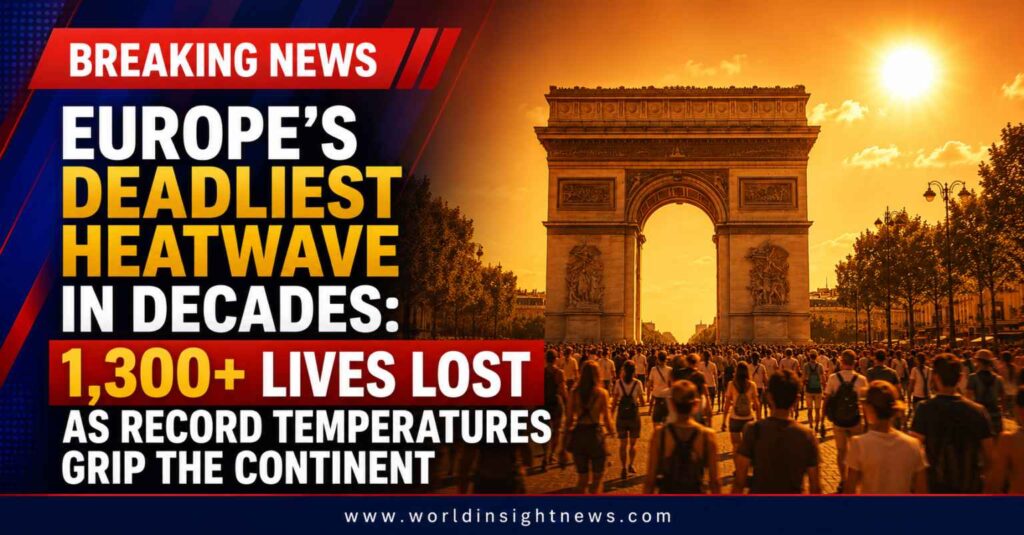
Europe’s Deadliest Heatwave in Decades: 1,300+ Lives Lost as Record Temperatures Grip the Continent
Introduction
Europe is experiencing one of the deadliest summers in its modern history. On June 28, 2026, the World Health Organization confirmed that over 1,300 excess deaths had been reported across the continent since June 21, all linked to a record-breaking heatwave.
This heatwave has shut schools, overwhelmed hospitals, damaged power grids, and pushed temperatures above 40°C in many countries.
WHO Director-General Tedros Adhanom Ghebreyesus clearly stated the facts. He referred to heat stress as the “silent killer.” The reason is simple: many European homes, schools, and workplaces were not built to withstand this level of heat. They were designed to keep warmth in during cold winters, not to fend off scorching summers.
With about 191 million people expected to face temperatures of at least 35°C in a single weekend, this design flaw is now costing lives at an alarming rate.
This isn’t an isolated incident. It is the most recent example of a trend that is becoming the new norm in Europe.
It raises an urgent question: what can governments do to prevent heat from claiming so many lives year after year?
How Bad Is It? A Country-by-Country Look
The numbers are staggering when broken down by country.
France has been hit hardest. The national health authority reported about 1,000 more deaths than usual in the days after June 24, with the sharpest rise among those aged 65 and older. Ambulance services answered over 122,000 calls at the height of the heatwave, according to Interior Minister Laurent Nuñez. Météo-France confirmed that June 23 was the hottest day on record since 1947, with one town reaching 44.3°C. Authorities placed 58 departments under red alert. Approximately 40 people drowned while trying to cool off in rivers and lakes, including a 21-year-old footballer who died in the Rhône.
Spain reported more than 400 heat-related deaths between Wednesday and Saturday, according to its Daily Mortality Monitoring System. Among the victims were a 90-year-old woman who died of heatstroke in a nursing home near Bilbao and a 68-year-old man in Almería. The national weather agency AEMET recorded its hottest June days ever, with several areas reaching temperatures above 40°C.
Germany confirmed at least seven heat-related deaths, including two people who drowned in Berlin while trying to cool down. The country broke its national temperature record twice in two days, ultimately hitting 41.7°C in the town of Coschen near the Polish border. Train services were halted on a major line in North Rhine-Westphalia, and trams were suspended in Leipzig.
The Czech Republic reached 41.1°C in Doksany — the first time that its official weather network recorded a temperature above 41°C.
Poland broke its all-time heat record at 40.5°C.
The United Kingdom saw its hottest June day ever, with a provisional 37.3°C in Suffolk.
Sweden recorded 327 heat-related deaths in less than a week, and a freight train derailed near Bollebygd due to warped railway tracks caused by the heat.
Italy faced disruptions too. Courts in Palermo had to suspend hearings because air conditioning systems failed. Genoa became the 18th Italian city to issue a red heat alert. The heat has also caused an ecological crisis along the Po River, where saltwater intruded 20 kilometers upstream, water flow dropped to a fraction of its usual rate, and environmental group Legambiente warned that water reserves could last less than three weeks.
Why This Heatwave Is Different
Europe has experienced two significant heatwaves this year. The first wave arrived in late May, pushing temperatures 10-15°C above normal.
The second, more intense wave began on June 17, just days before the summer solstice, and is responsible for the current death toll.
A quick analysis by World Weather Attribution deemed this the most severe heatwave ever recorded in the region studied. It concluded that heat of this magnitude in June would have been “virtually impossible” in 1976 without human-caused climate change.
Scientists involved in this analysis found that the unusually high nighttime temperatures during this event were roughly 100 times more likely than they would have been just two decades ago.
Tedros stated that heatwaves like this one are now about 30 times more likely than they were before the climate crisis began. An event that once occurred once every 300 years is now happening more than once a decade.
He explained that Europe is warming at about twice the global average, making it the fastest-warming continent on Earth.
Why Heat Actually Kills
It’s important to understand why hot weather can be so dangerous.
Garyfallos Konstantinoudis, a researcher at Imperial College London’s Grantham Institute, explains that extreme heat leads to heat stress. This occurs when the body can no longer regulate its temperature.
Heat stress can progress to dehydration and heat exhaustion, and in the worst cases, to heatstroke.
Heatstroke is a true medical emergency, where the body’s core temperature exceeds 40°C and does not cool down by itself. Heatstroke causes confusion, a racing heart, rapid breathing, and, without immediate treatment, can lead to organ failure or death.
Heat doesn’t only kill directly. It places significant strain on the cardiovascular and respiratory systems, leading to increases in heart attacks, strokes, and respiratory failures during heatwaves.
Those most at risk include older adults, infants, pregnant women, people with chronic illnesses, outdoor workers, migrants, and anyone without adequate housing, healthcare, or means to cool off.
Experts frequently emphasize nighttime heat. “Tropical nights,” when temperatures do not drop below 20°C even after dark, are especially harmful. The body never gets the chance to recover from daytime heat stress.
This effect is magnified in cities, where concrete and asphalt retain heat long after sunset. This phenomenon is known as the urban heat island effect.
Europe Has Been Here Before — and Hasn’t Fixed It
This crisis resembles one of the worst disasters in modern European history: the 2003 heatwave, which killed an estimated 14,800 people in France over about two weeks.
That disaster served as a wake-up call. The following year, France introduced a national heat plan that became a blueprint for the rest of Europe.
Yet, more than two decades later, the death toll continues to rise.
Just weeks before this year’s heatwave, WHO revealed that Europe has lost around 200,000 people to heat in the past four years — a toll that was emphasized as “nearly all preventable.”
Spain’s situation highlights a similar story. Researchers estimate that the country recorded 15,711 heat-related deaths in the summer of 2025.
Notably, most of these deaths — about 10,831 — were connected not to a single dramatic temperature spike but to extended exposure to moderately hot days and nights.
In other words, the slow build-up of heat stress over time can be just as deadly as an extreme record-breaking day.
What Countries Are Already Doing
The good news is that governments are not starting from scratch.
WHO’s European office has been urging countries to adopt Heat-Health Action Plans (HHAPs) — organized strategies covering early warning systems, healthcare readiness, and emergency response.
In 2026, WHO released a significantly expanded second edition of its guidance on how to create these plans, focusing on eight key elements.
France’s system, developed after 2003, serves as a clear example of an effective plan in action.
It uses a four-tier alert system. When the highest level is activated, the government opens a national crisis center to coordinate the response.
Local authorities are legally required to establish cool spaces, ensure access to drinking water, and monitor vulnerable residents.
Over the past two decades, French cities have planted more trees to combat the urban heat island effect, built shaded pathways and cycling routes, and converted public buildings into cooling centers for those without air conditioning at home.
Spain and Barcelona provide another model worth emulating.
Barcelona’s Climate Shelter Network, launched in 2019, has expanded to over 500 air-conditioned public spaces — libraries, museums, sports centers, schools, and shopping malls — where anyone can go to cool down, rest, and hydrate for free.
Municipal data indicates that 98% of Barcelona residents now live within a 10-minute walk of one of these spaces.
After a deadly 16-day heatwave in August 2025 that pushed temperatures to 45°C, Spanish Prime Minister Pedro Sánchez announced plans to broaden this model into a nationwide network, building on similar initiatives already running in Catalonia, the Basque Country, and Murcia.
Paris has implemented a similar program, converting over 800 public spaces into what the city refers to as “climate oases.”