Saudi Aramco resumes crude loadings from terminals inside Strait of Hormuz
By World Insight News DeskDUBAI — Aug. 19, 2026
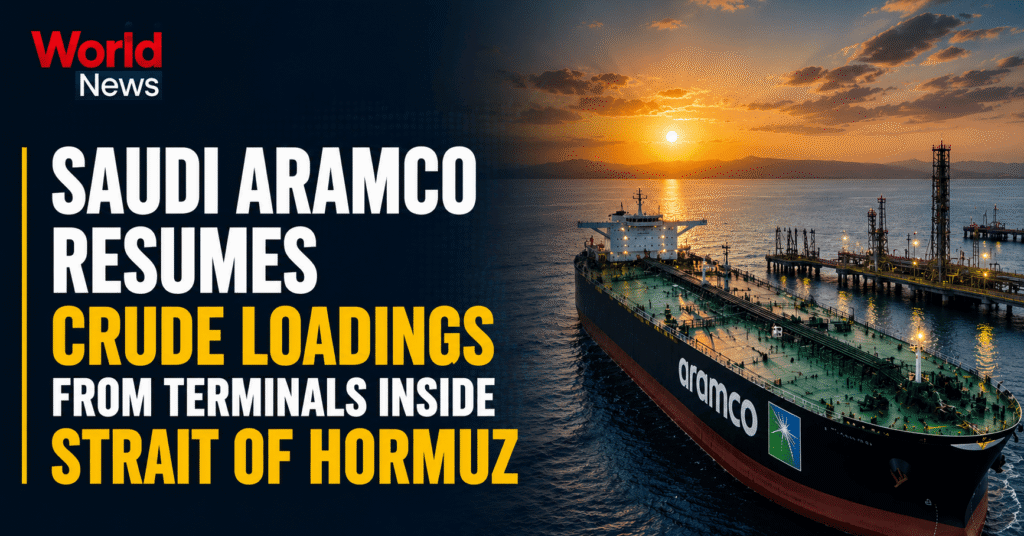
Saudi Aramco has resumed loading crude oil at terminals inside the Strait of Hormuz after a three-week gap and is offering cargoes to Asian buyers, according to ship-tracking data and trade sources.
Three very large crude carriers, tankers that each hold about 2 million barrels, loaded at the Juaymah and Ras Tanura terminals on Saudi Arabia’s eastern coast between Aug. 12 and Aug. 16, data from the tracking firms Kpler and Vortexa showed. The vessels were identified as the Malaysia Prosperity, the Algeria Prosperity and the Singapore Prosperity. The grades they carried were not immediately clear.
The loadings were the first at the two terminals in about three weeks. Saudi Aramco, the state oil company of the world’s largest crude exporter, had stopped selling cargoes from inside the strait for several weeks after attacks on its tankers there last month.
On Aug. 17, the company offered some Asian refiners cargoes of Arab Medium and Arab Heavy, its denser crude grades, for loading this month by ship-to-ship transfer off Fujairah in the United Arab Emirates. Saudi Aramco and Sinokor, the South Korean company that owns the three tankers, did not respond to requests for comment from Reuters, which first reported the resumption.
Vessels waiting at the strait
Provisional data from Kpler showed six more very large crude carriers could load Saudi crude from inside the strait later this month. Traders said Saudi Aramco could use Saudi-controlled tankers for the transits alongside Sinokor vessels, which would mark a change from recent practice.
Shipping data from LSEG showed on Aug. 18 that seven such tankers owned by Bahri, a Saudi state-linked shipping operator, were idling off the coasts of the United Arab Emirates and Oman, with two more sailing toward Fujairah.
Traffic through the waterway remains far below pre-war levels, though tracking providers differ on the daily counts. Before the conflict began, an estimated 120 to 140 vessels crossed the strait each day, roughly half of them tankers carrying about 20 million barrels of oil, according to figures cited by Al Jazeera, a Qatar-based broadcaster. Recent counts reported by tracking services have ranged from zero to a handful of crossings on individual days.
Iran’s Islamic Revolutionary Guard Corps, a branch of the country’s armed forces, has said only routes it designates may be used and that vessels must remain in contact with its naval units. Oman and the International Maritime Organization, the United Nations shipping agency, announced a separate corridor in June, which Iran said it did not accept.
The Fujairah arrangement
Fujairah lies on the Gulf of Oman side of the strait, outside the waterway itself. Transferring cargo between ships there allows buyers to collect Saudi barrels without sending their own vessels through the strait, shifting the transit risk to whichever tankers carry the oil out.
Heavier crude grades yield more residue fuel, which is used to power ships or is processed further at refineries into gasoline and diesel. Supply of those grades has been tight, and a return of Saudi cargoes could ease it.
Red Sea route under blockade
Saudi exports remain constrained on the country’s other side. Riyadh had rerouted much of its crude away from Hormuz through a pipeline running about 1,200 kilometres (750 miles) across the country to Yanbu on the Red Sea, which shipped roughly 4 million barrels per day at its peak.
In July, Yemen’s Houthi movement, which controls the country’s north including the capital, Sanaa, declared a maritime blockade of Saudi Arabia. The group said the measure was a response to Saudi actions, including a strike on Sanaa’s airport, and framed it as matching a blockade with a blockade. Saudi Arabia has condemned the declaration. Attacks subsequently reached Saudi tankers in the Red Sea.
Saudi shipments from Yanbu through the Bab el-Mandeb Strait, the passage between Yemen and the Horn of Africa, fell to 1.3 million barrels in the week of Aug. 3 from 11 million barrels in the week of July 20, according to Kpler data reported by CNBC.
Saudi Aramco has offered cargoes from Sidi Kerir, an Egyptian terminal on the Mediterranean reached by pipeline from the Red Sea, as a further alternative. About 670,000 barrels per day of Middle Eastern crude are expected to load there for Asian buyers this month, Kpler data showed, compared with none in the previous three months. Emma Li, a China market analyst at Vortexa, said the Sidi Kerir route appears not to be working for Asian customers, citing long voyages and high freight costs among Chinese buyers.
Background
The Strait of Hormuz, a channel between Iran and Oman through which about a fifth of the world’s seaborne oil and much of its liquefied natural gas normally passes, has been largely closed to commercial traffic since Feb. 28, when the United States and Israel began strikes on Iran and Iran restricted passage.
Saudi energy facilities have been hit repeatedly during the conflict. A drone attack on the Ras Tanura refinery on March 2 caused limited damage but prompted a shutdown; Saudi officials attributed the strike to Iran, which denied responsibility.
The United States and Iran signed a memorandum of understanding in June intended to reopen the strait to commercial shipping and allow 60 days of negotiation. The document expired on Aug. 17 without a successor agreement. President Donald Trump said the same day that he did not intend to extend it. Iran’s foreign ministry has said the strait will not fully reopen while a U.S. naval blockade of Iranian ports remains in place. Iran and Oman have continued separate talks on transit arrangements; Iranian officials have said coordinates for a route were agreed but that this does not amount to a reopening.
Brent crude, the international benchmark, traded near $91 a barrel on Aug. 18, a third consecutive session of gains and about 38% higher than a year earlier, according to market data compiled by Trading Economics.
What follows
The resumption does not restore Saudi export volumes to pre-war levels, and it does not indicate any agreement between Riyadh and Tehran on safe passage. Whether the additional loadings identified in provisional tracking data take place, and whether Bahri vessels are used, will be visible in shipping data over the coming weeks.
Saudi Aramco has made no public statement on the resumption, and the terms of the Fujairah offers have not been disclosed. Reports that buyers are predominantly Chinese refiners, and that tankers may switch off transponders during transits, could not be independently confirmed and are not included above.
Sources
Loading dates, vessel names and volumes are attributed to Kpler and Vortexa tracking data as reported by Reuters; vessel positions to LSEG; Red Sea and Sidi Kerir volumes to Kpler; price levels to market data providers. Statements by governments are attributed to the government making them.
Wire services and international press
- Reuters (via gCaptain), “Saudi Arabia Resumes Oil Loadings, Sales From Inside Strait of Hormuz.” https://gcaptain.com/saudi-arabia-resumes-oil-loadings-sales-from-inside-strait-of-hormuz/
- Reuters (via Business Standard), same report. https://www.business-standard.com/world-news/saudi-arabia-resumes-oil-loadings-sales-from-inside-strait-of-hormuz-126081801553_1.html
- OilPrice.com, “Aramco Puts VLCCs Back Into Hormuz After Three-Week Pause.” https://oilprice.com/Latest-Energy-News/World-News/Aramco-Puts-VLCCs-Back-Into-Hormuz-After-Three-Week-Pause.html
- CNBC, “Saudi Arabia ramps up oil exports through Mediterranean pipeline to avoid attacks in Red Sea.” https://www.cnbc.com/2026/08/12/saudi-arabia-iran-oil-red-sea-houthi-suez-canal-strait-hormuz.html
- CNBC, “Oil prices today: Uncertainty over U.S.-Iran Strait of Hormuz deal.” https://www.cnbc.com/2026/08/10/oil-prices-today-brent-wti-hormuz-trump-iran.html
Regional press and shipping trade press
- Oman Observer, “Saudi Arabia resumes oil sales from Hormuz.” https://www.omanobserver.om/article/1194676/business/energy/saudi-arabia-resumes-oil-sales-from-hormuz
- Baird Maritime, “Saudi Aramco restarts loading inside the Strait of Hormuz.” https://www.bairdmaritime.com/shipping/tankers/saudi-aramco-restarts-loading-inside-the-strait-of-hormuz-tankers-waiting-in-line
- Al Jazeera, “Saudi Arabia slams Houthi blockade: How will rest of the world be impacted?” https://www.aljazeera.com/news/2026/7/21/saudi-condemns-houthi-blockade-how-will-the-rest-of-the-world-be-impacted
- Al Jazeera, “Can the Suez save Asian oil consumers after Houthis shut Bab al-Mandeb?” https://www.aljazeera.com/news/2026/7/22/can-the-suez-save-asian-oil-consumers-after-houthis-shut-bab-al-mandeb
Background and prior developments
- Al Jazeera, “IRGC warns against new Hormuz route for ships” (June 25, 2026). https://www.aljazeera.com/news/2026/6/25/irgc-warns-against-new-hormuz-route-for-ships-what-we-know
- Al Jazeera, “Ships attacked in the Strait of Hormuz: What that means for ongoing talks” (July 7, 2026). https://www.aljazeera.com/news/2026/7/7/ships-attacked-in-the-strait-of-hormuz-what-that-means-for-ongoing-talks
- Offshore Technology (via Yahoo), “Iranian attacks prompt Aramco to shut Ras Tanura refinery.” https://www.yahoo.com/news/articles/iranian-attacks-prompt-aramco-shut-093135224.html
- Trading Economics, Brent crude price data and news stream. https://tradingeconomics.com/commodity/brent-crude-oil
- Korea Economic Daily (via Bloomingbit), “Trump Rules Out Extending Iran Truce MOU as Brent Settles Above $90.” https://en.bloomingbit.io/feed/news/118551
- AzerNews (citing Press TV), “Iran, Oman agree on new shipping route through Strait of Hormuz.” https://www.azernews.az/region/262441.html
Editor’s note on sourcing
The core reporting on the loadings originates with a single Reuters dispatch by Florence Tan and Siyi Liu, republished widely; OilPrice.com and Baird Maritime carried it independently but did not add original reporting. Where a wire story is cited here through a syndication partner, the originating Reuters URL should be substituted by any outlet holding the wire subscription.
Excluded for insufficient corroboration: claims that most prospective buyers are Chinese refiners, that sale details are being withheld for security reasons, and that Aramco may sail tankers with transponders disabled. These were attributed to Bloomberg by a secondary outlet but were not verified against Bloomberg’s own report.
Also excluded: remarks attributed to Trump about declaring the strait U.S. territory, and statements attributed to Iranian parliament speaker Mohammad Bagher Ghalibaf, each of which rests on a single outlet or on state media without independent confirmation.
Daily transit counts for the strait conflict between providers — reports for the same recent weekend range from none to five crossings — so no single figure is stated as fact. What Saudi Aramco intends for future loadings, which grades the three tankers carried, and whether Bahri vessels will make Hormuz transits have not been independently confirmed.