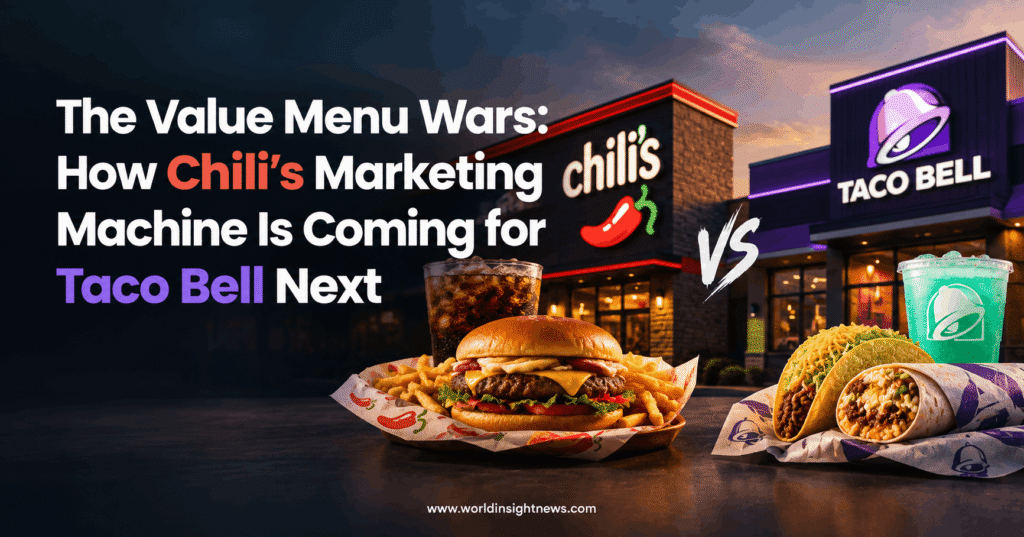
The Value Menu Wars: How Chili’s Marketing Machine Is Coming for Taco Bell Next
Chili’s spent most of this decade being furniture-store beige — the kind of chain people ate at out of habit, not desire. Now it’s the industry’s most-copied marketing case study, and it’s about to pick its next fight.
The turnaround, in numbers
Brinker International, Chili’s parent, just closed its fiscal 2026 having completed five consecutive years of same-store sales growth, delivering a 71% cumulative increase over that time, according to CEO Kevin Hochman. The most recent quarters have run especially hot: Chili’s posted 8.6% comparable sales growth in fiscal Q2 2026, extending a streak of 19 consecutive quarters of same-store sales growth. None of that is pricing sleight-of-hand, either — Brinker has been explicit that the growth is being driven by menu innovation, everyday value, and advertising that reinforces the brand’s value proposition and drives trial among new guests, not just charging more for the same food.
The fuel behind it is a marketing budget that’s roughly quadrupled. Reporting pegs Chili’s spend at $32 million in 2022 climbing to $137 million in 2025, redirected from traditional advertising toward what the company calls a culture-first, social-native approach. Chili’s promoted its CMO George Felix to Executive Vice President and Chief Marketing Officer of the whole company this March, expanding him beyond Chili’s into Maggiano’s — a vote of confidence tied directly to results. The company noted his tenure coincided with Brinker’s market capitalization rising from $1.3 billion at the start of his tenure to $6.25 billion by March 2026.
The playbook: hijack culture, then fight the giants
Chili’s marketing renaissance runs on two related tactics. The first is reactive: watch what’s already spreading online and pour resources into it before the moment passes. The clearest example is the Triple Dipper, an appetizer platter that started trending organically on TikTok around cheese-pull videos of its mozzarella sticks. Rather than stick to a media plan built around a different product launch, the team pivoted immediately — Felix has described the approach as deciding to “put gas on the fire” once they saw people jumping on it. The payoff was enormous: the Triple Dipper went from a $220 million menu item in 2024 to an $860 million item in 2026, now making up 16% of Chili’s sales.
The second tactic is offensive, not reactive: pick a fight with a much bigger fast-food chain, publicly and unsubtly. It started in 2024 with the Big Smasher burger, engineered as a direct shot at the Big Mac — Chili’s ran a campaign built around the idea that value-menu shoppers should feel sticker shock from the rising cost of fast food, with little change to the actual quantity or quality of fast food combo meals, in Felix’s words at the time. In 2025 that escalated into the Big QP Burger — the name stands for “Bigger than a Quarter Pound” — pitched with 85% more beef than a Quarter Pounder with Cheese and supported by a stunt pop-up called “Fast Food Financing” that mocked fast food’s rising prices as something requiring a loan. Earlier in 2026, the same formula got pointed at fried chicken, with the Big Crispy Chicken Sandwich launched to go after category leaders like Popeyes and KFC, a launch Brinker later credited with accelerating Chili’s momentum going into the summer.
What ties these together is a campaign umbrella called “Better Than Fast Food,” which frames Chili’s not as casual dining competing with Applebee’s, but as a sit-down alternative to the drive-thru — better food, comparable price, none of the trade-offs. It’s worked well enough that Felix has said publicly he sees a five-year runway of categories left to target this way.
The next target: Mexican QSR
That runway’s next stop is the Mexican fast-food category — Taco Bell, Qdoba, Chipotle and the rest. Felix confirmed the strategic intent directly, framing it as a natural extension of a formula that’s already beaten burgers and chicken: Chili’s leaders did not name Taco Bell specifically, but the brand believes it can replicate its “diss advertising” success against McDonald’s, arguing internally that Chili’s has earned the right to compete in that category next. Trade coverage has since reported that the expansion is real but not imminent — Felix has said an actual push into Mexican food is probably one to two years away, even as the five-year campaign pipeline stays active in the meantime.
The timing question is where this gets interesting. Taco Bell, the obvious (if unnamed) target, is coming off the worst stretch of its recent history. A nationwide cyclospora outbreak traced to lettuce from supplier Taylor Farms hit the chain hard starting in mid-July 2026. At its lowest point, Taco Bell’s customer visits on July 17 were roughly 31% below the chain’s average Friday traffic for the year to date, and the damage wasn’t brief — between July 6, when the outbreak became national news, and September 11, when the CDC declared it over, Taco Bell’s visitor traffic stayed down 12.2% year-over-year. Parent company Yum! Brands has said sales have since recovered materially and that brand sentiment has returned close to pre-crisis levels, but the episode dented what had been, going into the summer, Taco Bell’s strongest stretch ever — a 7% same-store sales increase and 9% system sales growth in the second quarter before the outbreak hit.
That’s a meaningfully different competitive backdrop than the one Chili’s walked into against McDonald’s. The burger and chicken campaigns leaned on a straightforward inflation narrative — fast food got expensive, we didn’t. A Mexican-QSR campaign inherits that same value argument, but it also lands at a moment when the category’s biggest player is still working to rebuild trust after a public health scare, and when a strong #2, Chipotle, has had its own food-safety history to contend with in past outbreaks. Whether Chili’s leans into that vulnerability explicitly or sticks to its usual “better value, better quality” framing without acknowledging the outbreak at all will say a lot about how far the brand is willing to push the “diss advertising” format.
Why the formula keeps working
Two structural things make this playbook repeatable rather than a one-off hit. First, Chili’s has paired the marketing with real operational investment — Hochman has pointed to declining “guests with a problem” complaint rates and climbing satisfaction scores as the less visible half of the turnaround, meaning the ads aren’t writing checks the restaurants can’t cash. Felix has made the same point about the underlying product: the goal has been making sure food and service in the restaurants is as good in person as it looks in the advertising. Second, the tone rides a specific cultural register — self-aware, a little absurdist, unafraid to be silly. Hochman has summed up the house style bluntly: Chili’s doesn’t take itself too seriously because at the end of the day, it’s just selling burgers and booze.
That’s a harder thing for a Mexican-QSR campaign to pull off than it sounds. Burgers and chicken sandwiches are commodity products with a near-universal cultural shorthand — everyone has an opinion about a Big Mac. Tacos and burritos carry more cultural weight and more scrutiny around authenticity, which means a “your queso is worse than ours” campaign risks landing very differently than “our burger has more beef than yours.” Chili’s has navigated adjacent territory carefully so far — the McDonald’s and KFC campaigns picked fights over price and portion size, not food culture. A Taco Bell campaign will test whether the same joke translates, or whether Chili’s needs a genuinely new angle once it moves off burgers and fries.
For now, the category remains unannounced and unlaunched — a stated intention from a CMO with a five-year game plan and a strong track record, not a live campaign. But given how directly Chili’s telegraphed its intentions with the Big Mac and Quarter Pounder campaigns before actually launching them, the direction of travel looks fairly clear: Taco Bell should probably expect company.