
UN Security Council rejects bid to extend Iran sanctions monitoring after Russia, China vetoes
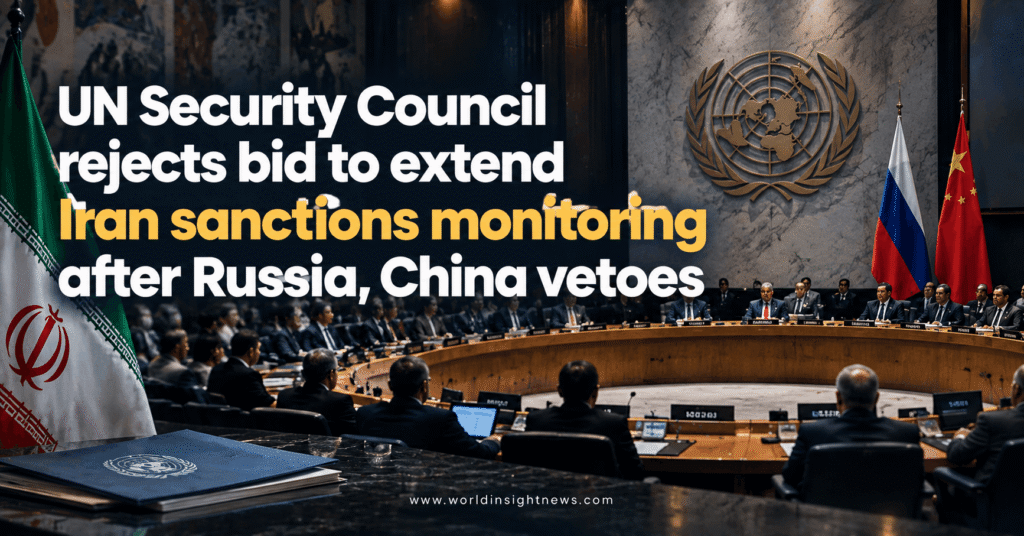
The United Nations Security Council failed on Thursday to renew the mandate of the panel of independent experts that monitors compliance with sanctions on Iran, after Russia and China cast vetoes against a resolution drafted by the United States.
The measure received 11 votes in favor, the minimum required for adoption, but was blocked by the negative votes of Russia and China, two of the council’s five permanent members. Pakistan and Somalia abstained. The panel’s mandate, which supports the work of the council’s Iran sanctions committee, was due to expire Sept. 26.
The resolution was put forward by the United States and would have extended the panel’s mandate for one year, until September 2027. Britain, France and Germany, the three European parties to the 2015 Iran nuclear deal, had pressed for the vote as council president France set the issue at the center of its September agenda.
Russia’s ambassador to the UN, Vassily Nebenzia, told the council the draft “was deeply flawed and did not have any legal basis,” and said Moscow and Beijing had urged Washington not to force a vote that would raise tensions in the council. Washington, he said, “decided to opt for confrontation.”
Dispute over the legal basis for sanctions
At the center of the standoff is a disagreement over whether UN sanctions on Iran are currently in force at all. Britain, France and Germany invoked the “snapback” mechanism under the 2015 nuclear agreement in August 2025, arguing Iran had fallen out of compliance with its obligations, and used it to reimpose sanctions effective Sept. 27, 2025. The move restored the council’s Iran sanctions committee, created in 2006 under Resolution 1737, and reauthorized a panel of experts to monitor implementation.
Russia and China dispute the legality of that step. Both governments maintain that Security Council Resolution 2231, which had endorsed the nuclear deal and set a schedule for lifting UN sanctions, reached its scheduled termination date on Oct. 18, 2025, and that the sanctions lapsed permanently at that point. In a joint statement in March, Moscow and Beijing said the council could not lawfully reestablish the sanctions committee or its panel of experts. Western council members reject that reading and say the sanctions took effect under the snapback process before the October deadline and remain in force.
The reimposed measures freeze Iranian assets abroad, restrict arms transactions with Tehran and bar the development of its ballistic missile program, among other steps. Those sanctions remain in place regardless of Thursday’s vote; what lapses is the mechanism for independent expert monitoring and reporting on potential violations.
Reaction from the parties involved
France’s UN ambassador, Jerome Bonnafont, who holds the council presidency this month, said sanctions enforcement was an important tool for pressing Iran to return to its nuclear commitments. The United States’ deputy ambassador, Jennifer Locetta, said Washington was not surprised by the vetoes, and argued that without the panel, the council would lose an independent source of reporting on sanctions violations, leaving a monitoring gap.
Iran’s mission to the UN said on social media that it appreciated Russia and China for what it called a principled stance, and characterized the US-led push as a renewed attempt to use the council for political ends. Tehran has consistently argued that the snapback process itself was invalid and that no sanctions should be in effect.
Background
The vote capped weeks of anticipation after France signaled in early September that a confrontation over the panel’s mandate was likely. It follows a separate Security Council vote nearly a year earlier, in September 2025, in which a Russian- and Chinese-sponsored draft resolution to extend sanctions relief for Iran under the nuclear deal was itself rejected, receiving only four votes in favor against nine against and two abstentions.
Tensions over Iran’s compliance have also played out beyond the council chamber this month. Earlier in the week, Austria revoked the visa of Iran’s nuclear chief, Mohammad Eslami, according to Iranian state media, after the Security Council declined to grant a waiver lifting his UN travel ban — a restriction tied to the snapback sanctions on officials linked to Iran’s nuclear and missile programs. Eslami and his delegation withdrew from the International Atomic Energy Agency’s annual conference in Vienna as a result.
Separately, the US Treasury and State Departments announced sanctions this week on two companies, identified as BitBank and Pishtaz Simorgh Electronic Trade Co., along with three associates of BitBank’s previously sanctioned former chief executive, Babak Zanjani, over their alleged role in helping Iran evade sanctions.
What follows
The immediate effect of Thursday’s vote is the lapse of the panel of experts, the body that had produced the council’s independent assessments of alleged sanctions violations. The sanctions committee established under Resolution 1737 has no fixed expiration date and continues to exist, but without the panel it loses its main channel for outside verification and reporting, according to the US delegation.
It remains unresolved, and unconfirmed by independent reporting, whether the council will attempt an alternative monitoring arrangement outside a panel of experts, or whether the broader dispute between the US-aligned council members and Russia and China over the legal status of the snapback sanctions will be revisited in another forum.
Sources
Reporting on the vote count, statements by Russian and French envoys, and the Eslami visa episode is corroborated across international wire coverage and the Al Jazeera account below. Background on the snapback mechanism and the September 2025 vote draws on Reuters wire reporting carried by regional outlets.
Wire services and international press
- Al Jazeera, “Russia, China veto UN mandate to monitor Iran sanctions.” https://www.aljazeera.com/news/2026/9/17/russia-china-veto-un-mandate-to-monitor-iran-sanctions
- Associated Press via Local10, “Russia and China veto US proposal for UN experts to keep monitoring sanctions on Iran.” https://www.local10.com/news/politics/2026/09/17/russia-and-china-veto-us-proposal-for-un-experts-to-keep-monitoring-sanctions-on-iran/
- Euronews, “UN Security Council fails to adopt US-backed Iran sanctions resolution after Russia and China vetoes.” https://www.euronews.com/2026/09/18/russia-and-china-veto-us-backed-resolution-to-monitor-iran-nuclear-sanctions
- The National, “Russia and China veto US draft to extend UN monitoring of Iran sanctions.” https://www.thenationalnews.com/news/us/2026/09/17/russia-and-china-veto-us-draft-to-extend-un-monitoring-of-iran-sanctions/
Background and prior proceedings
- Reuters via Al-Monitor, “UN faces contentious Iran nuclear vote ahead of General Assembly” (Sept. 1, 2026). https://www.al-monitor.com/originals/2026/09/un-faces-contentious-iran-nuclear-vote-ahead-general-assembly
- UN News, “UN Security Council blocks China-Russia resolution on Iran sanctions” (Sept. 2025 vote on JCPOA extension). https://news.un.org/en/story/2025/09/1165974
Editor’s note on sourcing The Iran mission’s social-media statement was paraphrased rather than quoted at length, consistent with the wire desk’s copyright and quotation limits; only its substance — thanks to Russia and China and a characterization of the US move as political — is reported. One account (The National) referenced two abstaining states but named only Pakistan; Somalia as the second abstaining state is corroborated by three other outlets (Al Jazeera, AP and Euronews) and is reported here as confirmed. The precise vote breakdown on any future alternative monitoring arrangement is not yet available and is not reported.