Why Does the US Want Greenland? The 80-Year History Behind Trump’s Latest Claim
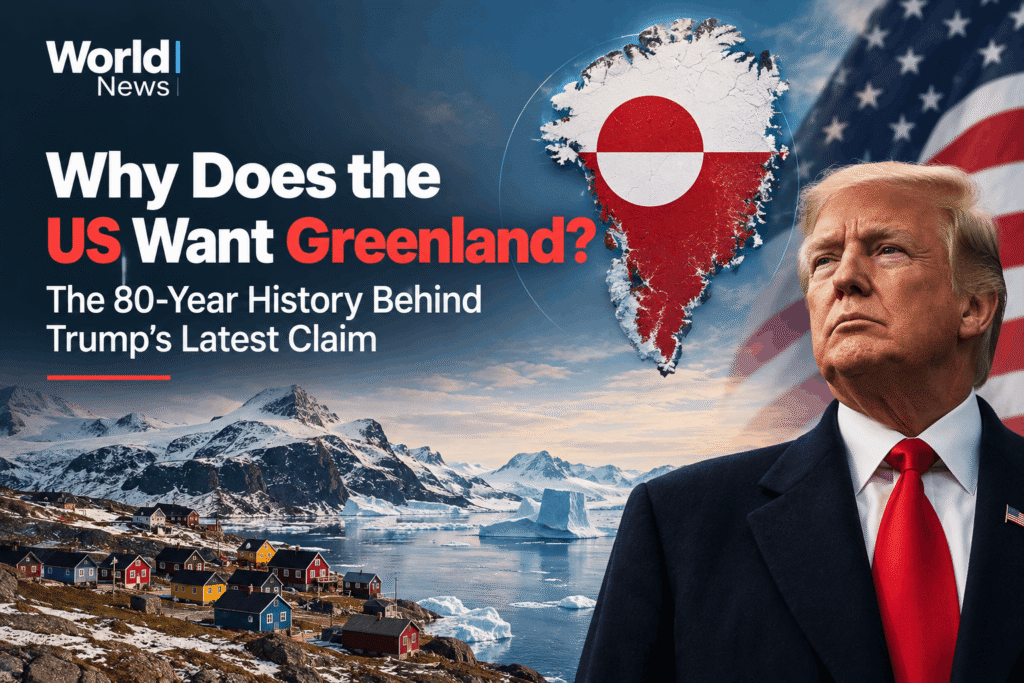
President Donald Trump’s campaign to bring Greenland under American control, which escalated into threats of tariffs and military force in January before easing into a still-unfinished “framework” agreement, is the fourth serious American attempt in roughly 160 years to acquire the Danish territory.
Trump said Greenland was needed for national security and accused China and Russia of eyeing the island, statements Denmark and Greenland’s governments have disputed. Greenland’s prime minister, Jens-Frederik Nielsen, and Denmark’s prime minister, Mette Frederiksen, have said repeatedly that the territory is not for sale. European Commission President Ursula von der Leyen said on Sept. 6 that the European Union stands with Greenland, as the bloc announced new funding for the island.
A U.S.-Denmark-Greenland working group has met periodically since Trump and NATO Secretary-General Mark Rutte announced a “framework of a future deal” on Jan. 21, though no agreement has been signed and officials on both sides say the terms remain unresolved.
A colonial-era proposal, then a Cold War offer
American interest in Greenland did not begin with Trump. Secretary of State William Seward, who negotiated the 1867 purchase of Alaska from Russia for President Andrew Johnson, also explored acquiring Greenland and Iceland around the same time, according to State Department historical records cited by multiple outlets. That effort went nowhere, and only the Alaska deal was completed.
The most concrete historical precedent came after World War II. The United States took over the defense of Greenland in 1941, when Denmark’s ambassador in Washington, acting without his German-occupied government’s authorization, signed an agreement granting the U.S. military base rights on the island in exchange for protection. American forces used Greenland as a refueling stop and a base for anti-submarine operations, a role the Pentagon later described as making the island function like a stationary aircraft carrier.
With the Cold War beginning, President Harry Truman’s administration made a formal offer in 1946 to buy Greenland from Denmark for $100 million in gold, an amount that would be worth roughly $1.7 billion today. A Joint Chiefs of Staff planning memo from that period, declassified decades later and first reported publicly by a Danish newspaper in 1991, said Greenland was “completely worthless to Denmark” but indispensable to American security. Denmark’s foreign minister rejected the offer, saying his country did not believe it owed the United States the entire island despite wartime debts.
As part of the same overture, Truman’s government proposed trading part of Alaska’s Point Barrow district, including any future oil rights there, for portions of Greenland. Denmark declined that swap as well. Point Barrow later produced the largest oil strike in U.S. history, in 1967.
Interest resurfaced in 1955, when the Joint Chiefs sent a classified memo urging President Dwight Eisenhower to try buying Greenland again. No formal offer followed. Instead of a sale, the U.S. and Denmark signed a 1951 defense agreement that gave American forces continued rights to build and operate bases on the island without transferring sovereignty. That arrangement, later updated, remains the legal basis for the U.S. military presence in Greenland today.
Decades of bases, then a return to acquisition talk
For much of the following half-century, Washington’s interest in Greenland centered on basing rights rather than ownership. At the height of the Cold War, roughly 10,000 U.S. troops were stationed at what was then called Thule Air Base, now the Pituffik Space Base, which the Space Force operates for missile-warning and space-surveillance missions. Personnel levels have fallen sharply since; a recent estimate put the base’s staffing at around 150 to 200 people.
Talk of acquisition returned in August 2019, when Trump, in his first term, said buying Greenland would amount to a large real-estate deal that would serve U.S. security interests. Denmark’s then-prime minister called the idea absurd, and Trump postponed a planned state visit in response. The proposal did not advance further during his first term.
The idea resurfaced after Trump’s return to office in January 2025, when his son Donald Trump Jr. made a personal visit to Greenland that drew international attention. Pressure escalated sharply in January 2026: Trump said the U.S. needed Greenland “from the standpoint of national security” and, for a period, did not rule out using military force to take it. He also threatened tariffs of up to 25% on Denmark and several other European countries unless a deal was reached to cede the territory. Nielsen accused Trump of “utterly unacceptable” rhetoric, and large protests took place in Nuuk, Copenhagen and other cities, including what organizers described as the largest demonstration in Greenland’s history.
Trump reversed course at the World Economic Forum in Davos on Jan. 21, saying he would not use force, then announced the framework agreement with Rutte hours later. He has since said the arrangement could involve U.S. mineral rights and the stationing of components of the Golden Dome missile-defense system on the island, though Danish officials say there have been no direct discussions about ceding sovereign territory.
Minerals and melting ice add new stakes
Unlike the Cold War-era disputes, which centered almost entirely on military basing, the current push has an added economic dimension. Greenland holds deposits of rare earth elements and other minerals used in electronics, wind turbines and defense systems; the U.S. Geological Survey has estimated the island holds about 1.5 million tonnes of mineable rare earth reserves, though it currently produces none. China controls a large share of global rare earth processing, and U.S. officials, including Vice President JD Vance, have said Washington wants to prevent Beijing or Moscow from expanding influence in the Arctic as melting ice opens new shipping routes.
A Chinese-linked rare earth project near the Greenlandic town of Narsaq was effectively halted in 2021 amid local opposition and political disputes, and the company involved is now suing the Greenlandic government over the shutdown. Greenland’s government has said it welcomes foreign investment in mining but has resisted proposals it sees as compromising its autonomy.
What follows
Denmark, Greenland and the United States have not published a text of any agreement, and officials on both sides describe the January framework as a starting point for negotiations rather than a settled outcome. The working group established after the Davos announcement has continued meeting, and the European Union has moved to bolster its own ties with Greenland, announcing new funding this month that officials described as support for Arctic security and economic development. Whether the framework leads to a formal deal, and what such a deal would contain, remains unconfirmed.
Sources
Historical details on U.S. purchase attempts are drawn from CNN’s review of declassified U.S. and Danish records and from background reporting by No Labels and Nordics.info; current developments are drawn from wire and broadcast reporting, the UK House of Commons Library and CSIS analysis.
Wire services and international press
- CNN, “The US has tried to acquire Greenland before – and failed.” https://www.cnn.com/2026/01/07/politics/us-greenland-trump-denmark-history-hnk
- AP via PBS NewsHour, “Trump again demands Greenland as NATO unveils military projects worth billions.” https://www.pbs.org/newshour/world/trump-again-demands-greenland-as-nato-unveils-military-projects-worth-billions-to-prove-its-firepower
- Al Jazeera, “Trump’s Greenland ‘framework’ deal: What we know about it, what we don’t.” https://www.aljazeera.com/news/2026/1/22/trumps-greenland-framework-deal-what-we-know-about-it-what-we-dont
- CNBC, “Greenland welcomes major funding boost from EU amid Trump’s annexation threats.” https://www.cnbc.com/2026/09/07/greenland-eu-trump-critical-minerals-arctic.html
- ABC News, “Here’s what we know about Trump’s ‘framework’ of a Greenland deal.” https://abcnews.com/Politics/trumps-framework-greenland-deal/story?id=129470995
Background and historical proceedings
- Nordics.info, “Buying Greenland? Trump, Truman and the ‘Pearl of the Mediterranean.'” https://nordics.info/show/artikel/buying-greenland-trump-truman-and-the-pearl-of-the-mediterranean
- No Labels, “America’s Long History of Trying to Buy Greenland.” https://nolabels.org/the-latest/americas-long-history-of-trying-to-buy-greenland/
- CBC, “Why Trump wants to buy Greenland: A history of U.S. land acquisitions.” https://www.cbc.ca/1.5255027
- CSIS, “Greenland, Rare Earths, and Arctic Security.” https://www.csis.org/analysis/greenland-rare-earths-and-arctic-security
- UK House of Commons Library, “President Trump and Greenland: Frequently asked questions.” https://commonslibrary.parliament.uk/research-briefings/cbp-10472/
Editor’s note on sourcing Figures on current U.S. troop levels at Pituffik Space Base vary by source (roughly 150 to 200 personnel) and are presented here as an approximate range rather than a precise count. Claims made by Trump regarding Chinese and Russian ships surrounding Greenland have been characterized as false by fact-checkers and independent reporting and are reported here as disputed claims, not as fact. The precise contents of the January 2026 “framework” deal remain undisclosed by all parties as of this writing and are described accordingly as unconfirmed.