Toll from Yemen clashes passes 300 as civilians flee homes
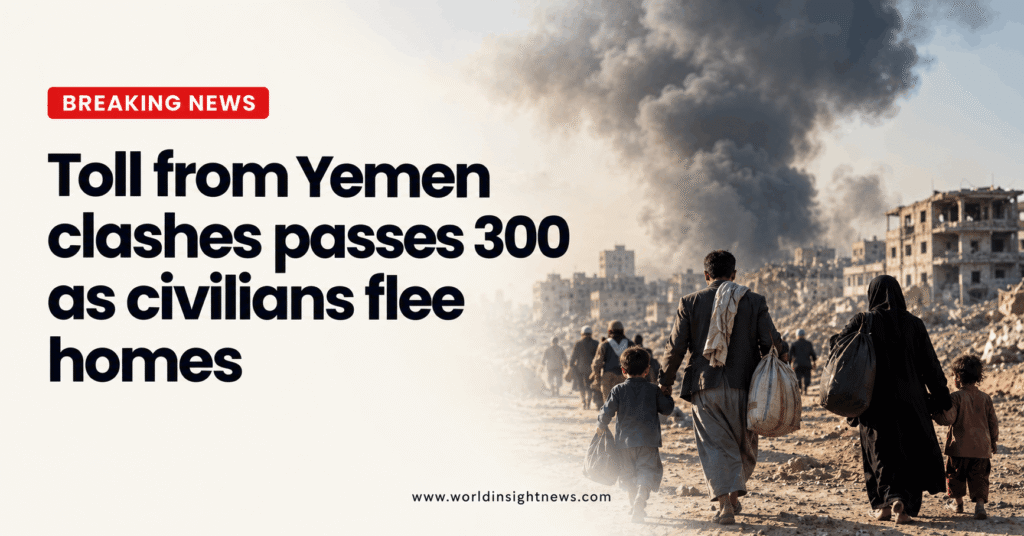
Toll from Yemen clashes passes 300 as civilians flee homes
The death toll from days of fighting between Yemen’s internationally recognized government and the Houthi movement climbed past 300 on Sunday, as hundreds of families fled their homes in the country’s southwest to escape the violence.
Two military officials with the Saudi-backed government forces told the news agency AFP that 84 of their troops were killed between midday Saturday and early Sunday, mostly in missile attacks. Four Houthi military sources said 57 rebel fighters were killed over the same period. According to a tally AFP compiled from military and medical sources on both sides, more than 300 combatants and some civilians have been killed since the Houthi assault began on Thursday.
Fighting over a Red Sea gateway
The two sides have been fighting for days for control of territory near the Bab al-Mandab strait, a chokepoint for Red Sea shipping. It is the deadliest flare-up in Yemen since a 2022 ceasefire broke down in July.
The Houthis, who are backed by Iran, launched simultaneous ground attacks on Thursday against government positions in southern Hodeidah province and three districts west of the city of Taiz, preceded by heavy artillery fire, missiles and drones, according to Yemeni army statements reported by regional outlets. The assault initially pushed government forces back from several positions in Taiz’s Jabal Habashi district before troops recaptured some ground the following day.
A risk analyst who follows Yemen, cited by AFP, said the Houthis were seeking to extend their control over the Bab al-Mandab strait. Government forces said they had since retaken a district called Hays, at the junction of Hodeidah, Taiz and Ibb provinces, and advanced in western Taiz. The presidential council’s chairman, Rashad al-Alimi, said the armed forces were capable of restoring control over the country and that Houthi miscalculations would lead to their defeat. The Houthis have not issued a public assessment of the latest fighting comparable in scope to the government’s; a Houthi military spokesman had earlier this year claimed attacks on shipping and coalition vessels in the same area.
Civilians caught between the fronts
Families fleeing fighting in the Maqbanah and Jabal Habashi districts of Taiz governorate took refuge over the weekend at Al-Bareen camp for displaced people, and AFP journalists saw more families arriving at a separate camp in the area with mattresses, livestock and other belongings.
One woman displaced from Jabal Habashi, Nimah Saif, said she saw people killed and wounded in the fighting and that her group could not help them. “Now we are stranded here, hungry, with nothing to eat,” she said.
The United Nations agency for humanitarian coordination, OCHA, said Friday that an estimated 1,790 households had been displaced by what it called intense shelling and clashes in the two districts. A spokesman for UN Secretary-General António Guterres said he was deeply concerned by the fighting and warned of serious political, economic and security consequences for Yemen.
Background
Yemen’s civil war between the Houthi movement, which controls much of the country’s north including the capital Sanaa, and the internationally recognized government, backed by a Saudi-led coalition, has run for more than a decade. A UN-brokered truce reached in 2022 sharply reduced large-scale fighting for several years. The Houthis separately carried out repeated attacks on shipping in the Red Sea, which they described as actions in solidarity with Palestinians during the war in Gaza, drawing retaliatory strikes from the United States and further entangling Yemen in the wider regional conflict.
Clashes between the two sides resumed on a smaller scale in early July, and the truce collapsed the same month. Fighting has intensified since, including strikes on the government-held port of Mokha in August that killed and wounded people there. Thursday’s offensive was described by officials on both sides as the largest since the 2022 truce took hold.
What follows
One government military official said fighting had subsided in the early hours of Sunday, with government forces establishing positions north of a frontline district roughly 30 kilometers inland from the Red Sea coast, while the Houthis were reported to have advanced elsewhere toward the west. The overall trajectory of the fighting, and whether the current escalation will settle into a wider return to civil war, remains unresolved and unconfirmed as reporting continues.
Sources
Casualty figures and troop movements are attributed to AFP’s tally of military and medical sources on both sides; civilian and humanitarian details are attributed to OCHA and displaced residents quoted by AFP; background on the wider conflict draws on regional and international coverage.
Wire services and international press
- Arab News (AFP), “Toll from Yemen clashes passes 300 as civilians flee homes.” https://www.arabnews.com/middle-east/toll-from-yemen-clashes-passes-300-as-civilians-flee-homes-3000718
- The Times of Israel (AFP), “Over 60 killed in Yemen as Houthis battle Saudi-backed forces near Red Sea gateway.” https://www.timesofisrael.com/over-60-killed-in-yemen-as-houthis-battle-saudi-backed-forces-near-red-sea-gateway
Regional press (proceedings and on-the-ground reporting)
- Al Jazeera, “Houthi attacks on Yemen’s Taiz escalate, triggering new displacement wave.” https://www.aljazeera.com/news/2026/9/4/houthi-attacks-on-yemens-taiz-escalate-triggering-new-displacement-wave
- Al Jazeera, “How significant are the Yemeni government’s military gains against Houthis?” https://www.aljazeera.com/news/2026/9/6/how-significant-are-the-yemeni-governments-military-gains-against-the-houthis
- Arab News, “Yemeni government forces push back against Houthi offensive in Taiz, Hodeidah.” https://www.arabnews.com/middle-east/yemeni-government-forces-push-back-against-houthi-offensive-in-taiz-hodeidah-3000519
Background and prior proceedings
- Council on Foreign Relations, “Conflict in Yemen and the Red Sea,” Global Conflict Tracker. https://www.cfr.org/global-conflict-tracker/conflict/war-yemen
- Al Jazeera, “Yemeni government escalates attacks against Houthis: What’s next?” (Aug. 18, 2026). https://www.aljazeera.com/news/2026/8/18/yemeni-government-escalates-attacks-against-houthis-whats-next
Editor’s note on sourcing This account relies heavily on AFP’s wire reporting, which is the only outlet with journalists reporting from displacement camps in Taiz governorate; that reporting has been syndicated near-identically across multiple outlets and is treated here as a single source rather than independent corroboration. I could not find a comparably detailed, on-record Houthi statement responding to the specific casualty figures or displacement claims in this report; where the Houthi side’s position on the current offensive’s aims is described, it draws on prior public statements and third-party analysis rather than a direct rebuttal, and that gap is noted rather than filled in. Overall casualty and displacement figures should be read as estimates compiled during active fighting and are likely to be revised.