The Strait of Hormuz: Why the World’s Most Dangerous Waterway Keeps Making Headlines
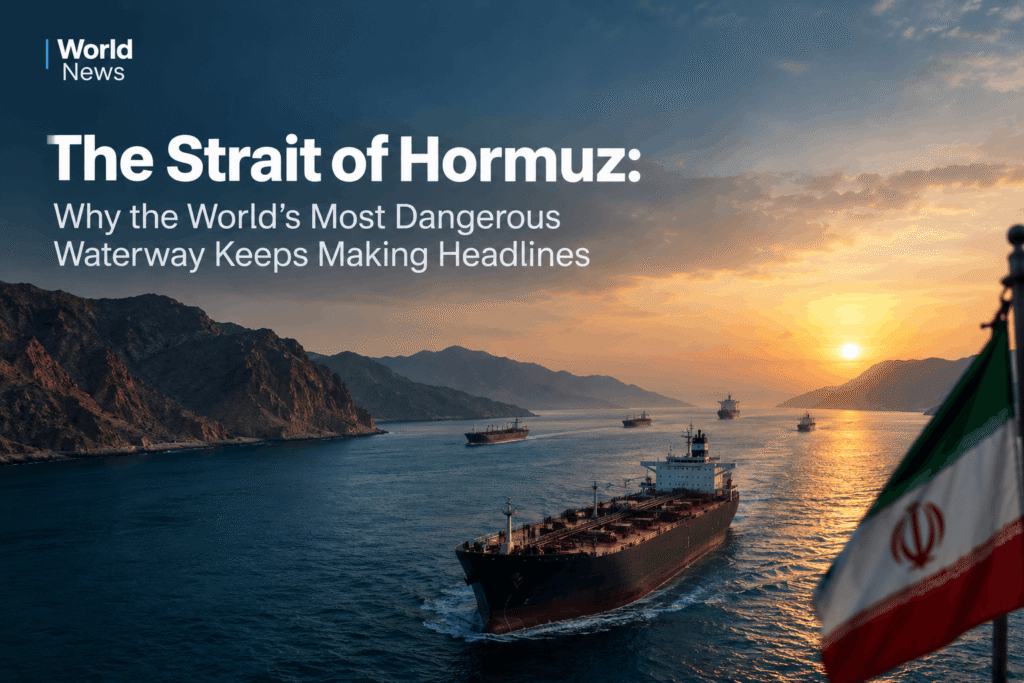
Tankers move through the Strait of Hormuz, the narrow channel between Iran and Oman that carries about a fifth of the world's oil.
A 21-mile-wide channel between Iran and Oman has disrupted global oil markets for a sixth straight month, as the United States and Iran continue to trade strikes over who controls the passage that normally carries about one-fifth of the world’s oil.
The Strait of Hormuz links the Persian Gulf to the Gulf of Oman and the open ocean, and it is the only sea route out of the Gulf for oil-exporting states including Saudi Arabia, Iraq, Kuwait, Qatar, the United Arab Emirates and Iran itself. The strait has been at the center of fighting since the United States and Israel opened a military campaign against Iran on Feb. 28, 2026, after which Iranian forces moved to restrict shipping through the waterway, according to U.S. and Iranian officials. A U.S. naval blockade of Iranian ports, imposed April 13 after ceasefire talks broke down, remains in place, and a memorandum of understanding the two sides signed in June expired Aug. 17 without a lasting settlement, according to the Khaleej Times. Fighting resumed the following month.
The most recent escalation came Saturday, when U.S. Central Command said Iran’s Revolutionary Guard Corps fired ballistic missiles at a U.S. aircraft carrier and a guided-missile destroyer in the Gulf. Neither ship was hit, the command said. In response, U.S. forces struck three Iranian oil tankers, permanently disabling two — one off Kharg Island, Iran’s main oil export terminal, and one near Jask — and destroying a third, unladen vessel in the Gulf of Oman, which later sank, Central Command said. Adm. Brad Cooper, the command’s chief, said the vessels were part of a network funding the Revolutionary Guard and its regional allies, a characterization Iran disputes.
Iran’s Foreign Ministry called the strikes illegal and said Washington would bear responsibility for the consequences of what it described as continued aggression. Mohammad Bagher Ghalibaf, speaker of Iran’s parliament and its chief negotiator with Washington, said in a Sunday speech that “the era of ‘proportionate responses’ is over,” and Tehran has said its retaliation will be more forceful going forward.
A new zone, and a shipping war measured in barrels
Iran’s Supreme National Security Council said Sunday it would soon announce a “restricted” or “exclusion” zone stretching from the line of the U.S. blockade, through the Strait of Hormuz and into parts of the Persian Gulf. Mohsen Rezaei, the council’s secretary, said on state television that any vessel entering the zone to transit the strait would be added to an Iranian sanctions list, though he gave few further details, according to the Khaleej Times. Iran also said it plans to publish maps of an alternative shipping corridor through the strait.
The two governments offer starkly different accounts of how much oil is actually moving. U.S. Energy Secretary Chris Wright told CNN that transits through the strait are averaging more than 9 million barrels a day and that, combined with pipelines that bypass the waterway, flows are at roughly two-thirds or more of pre-war levels. President Donald Trump has said the U.S. Navy is helping guide dozens of tankers through the strait each night. Independent tracking tells a different story: the analytics firm Kpler recorded a 10-day average of about 13 vessels a day crossing the strait as of Sunday, down from more than 15 a day earlier in the week, Gulf News reported, with only two vessels crossing on Saturday and six on Sunday. Shipowners have largely avoided the chokepoint, and some vessels that do cross do so with their tracking transponders switched off.
Brent crude, the international oil benchmark, traded at a seven-week high near $99 a barrel Tuesday, CBS News reported, extending an upward run since late August. The increase in fuel costs comes as Trump’s Republican Party heads into November elections in which control of Congress is at stake, the Khaleej Times noted.
The human and commercial toll
The disruption has stranded roughly 6,000 sailors aboard hundreds of ships in the Persian Gulf, according to the International Maritime Organization, the United Nations’ maritime agency, which said 19 seafarers have been killed and at least 70 attacks on international shipping recorded since the war began Feb. 28. A separate tally puts the death toll at 20 seafarers and one port worker; the discrepancy reflects the difficulty of independently verifying casualties in an active conflict zone, and this article uses the more conservative, UN-sourced figure. A network of ship-to-ship oil transfers has emerged off Fujairah and Sohar, on Oman’s Gulf of Oman coast, as exporters look for ways to move crude without sending tankers through the strait itself.
Gulf Cooperation Council Secretary-General Jasem AlBudaiwi said regional trust with Iran has returned to “square one,” and that Bahrain, Qatar and Kuwait faced acute logistical strain when the strait was effectively closed, given their geography. He pointed to a U.N. Security Council resolution adopted in March that condemned Iranian attacks on Gulf states and Jordan and specifically condemned threats to close or obstruct the strait, arguing existing international law, not a new arrangement, should govern the waterway.
Why this stretch of water keeps recurring as a flashpoint
Geography is the underlying reason a single conflict can reach global energy markets so quickly. At its narrowest point the strait is about 21 miles across, with tankers using two shipping lanes — each roughly two miles wide, separated by a two-mile buffer — that run through Omani territorial waters. Before the war, roughly 20 million barrels of oil passed through the strait each day, equivalent to about one-fifth of global petroleum consumption, according to the U.S. Energy Information Administration. Pipeline alternatives exist — Saudi Arabia’s East-West line to the Red Sea and a UAE line to Fujairah — but their combined spare capacity is a small fraction of normal Hormuz volumes, and Qatar’s liquefied natural gas exports, loaded inside the Gulf, have no pipeline bypass at all.
The strait’s last comparable crisis came during the Iran-Iraq War of the 1980s, when both countries attacked tankers in what became known as the Tanker War. The United States reflagged Kuwaiti tankers and escorted them through the strait; Iran laid naval mines, one of which nearly sank the USS Samuel B. Roberts in 1988, prompting a U.S. retaliatory strike on Iranian oil platforms. Even then, analysts have noted, the strait was never fully closed for a sustained period — a distinction some say has not held during the 2026 conflict, when the credible threat of attack alone was enough to curtail most transits for months.
What remains unresolved
Iran has not published the coordinates or start date of its planned exclusion zone, and it remains unclear how the zone would be enforced or how it relates to the existing U.S. blockade line. U.S. officials have not detailed how they calculate current daily transit volumes, and independent tracking firms report figures well below those cited by Washington. Neither government has said whether the August memorandum of understanding can be revived, and the death toll from six months of attacks on shipping has not been independently confirmed by a single authoritative source.
Sources
Casualty figures are attributed to the International Maritime Organization via Fox News; U.S. and Iranian government statements are attributed to their respective spokespeople as reported by wire and broadcast outlets below.
Wire services and international press
- CNN, “US military strikes three Iranian tankers in retaliation for missile attacks.” cnn.com
- The Associated Press via CBC News, “U.S. military hits 3 Iranian oil tankers after saying its navy warships were targeted.” cbc.ca
- Reuters/CBS News, “Live Updates: Iran says it will expand control in Strait of Hormuz as oil and gas prices continue to climb.” cbsnews.com
- Al Jazeera, “US, Iran engaged in tanker war: Where is the months-long conflict headed?” aljazeera.com
- Al Jazeera, “How much oil is going through Hormuz? Why data doesn’t match US claims.” aljazeera.com
- Fox News Digital, “Strait of Hormuz traffic remains below normal as US sanctions pressure Iran.” foxnews.com
- NPR, “U.S. strikes Iranian oil tankers after Navy ships targeted.” npr.org
- Fortune, “Iran plans to announce an ‘exclusion zone.'” fortune.com
Local and regional press (Gulf perspective)
- Khaleej Times, “Iran to announce new ‘restricted zone’ outside Hormuz strait in coming days.” khaleejtimes.com
- Khaleej Times, “‘Ball is in Iran’s court’: GCC chief says Tehran must rebuild Gulf trust after attacks.” khaleejtimes.com
- Gulf News, “Live updates: Iran plans ‘exclusion zone’ near Strait of Hormuz in coming days.” gulfnews.com
Background and prior proceedings
- U.S. Energy Information Administration, “Amid regional conflict, the Strait of Hormuz remains critical oil chokepoint.” eia.gov
- Encyclopaedia Britannica, “Strait of Hormuz.” britannica.com
- Congressional Research Service via Congress.gov, “The Strait of Hormuz: Security Developments and Impacts on Oil, Gas, and Other Commodities.” congress.gov
Editor’s note on sourcing Casualty and shipping-traffic figures vary by source; where outlets disagreed, this article used the more conservative or better-attributed figure and noted the discrepancy rather than presenting a single number as settled. Details of Iran’s planned “exclusion zone” — its exact boundaries and enforcement mechanism — have not been published by Tehran and are omitted pending an official announcement. U.S. claims about nightly transit volumes and Iranian claims of “full control” over the strait are both reported as claims, not independently verified facts, because they conflict with third-party shipping-tracking data.