
Dubai firm turns desert sand into building blocks that cut cement use nearly in half
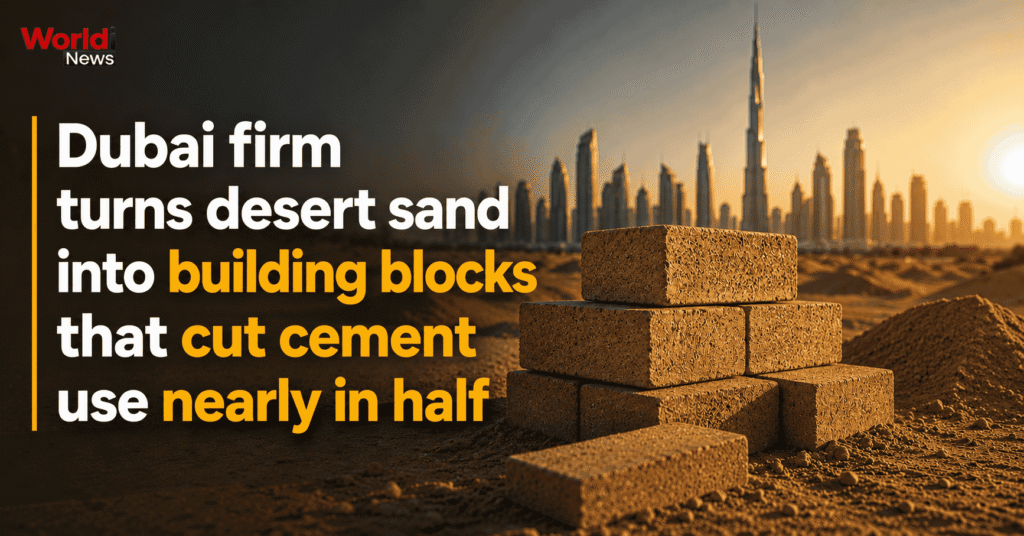
ARDH Collective's DuneCrete blocks are made largely from local desert sand and use up to 50% less cement than standard concrete, the company says. (World News)
By World Insight News Desk
DUBAI — Aug. 21, 2026
A Dubai-based materials company, ARDH Collective, says it has developed a concrete alternative made largely from local desert sand that uses up to 50% less cement than conventional concrete, offering the construction industry a lower-carbon building block.
The material, called DuneCrete, is used to make hollow blocks, pavers, facade panels and other architectural elements. Its most visible product, a perforated breeze block called DuneBlock, is rated by the company’s current data sheet at a compressive strength of about 5,660 pounds per square inch. ARDH Collective says the mix also carries up to 50% less embodied carbon than standard concrete.
The company was founded by three designers and architects — Alhaan Ahmed, Alyina Ahmed and Maximo Tettamanzi — who began developing the material as a university research project before commercializing it in 2021. It has since been used in a handful of design installations in the UAE, most recently a pavilion at Dubai Design Week 2025 called “The Space Within,” built from DuneBlock units.
The company says ordinary concrete requires river or coastal sand because its grains are rough enough to interlock and bind. Desert sand, by contrast, is worn smooth and rounded by wind, which a 2026 concrete study cited by the company found makes it poorly suited to conventional mixes. ARDH says it addressed that limitation by reformulating the binder and additives around the sand rather than changing the sand itself, though it has not published the mix design.
Why imported sand became the industry norm
The UAE sits beside vast stretches of desert, but ARDH’s founders say the country has long imported river sand for construction because conventional concrete needs aggregate with a specific shape and surface texture that dune sand lacks. The result, industry accounts note, is a market that ships in sand from other regions even as local dunes go unused.
Reformulating concrete around fine, rounded grains rather than importing coarser sand is not new in principle — researchers in China and elsewhere have tested desert sand blends for years — but ARDH says its version is engineered specifically for the UAE’s building codes and climate, including resistance to the sulfate-rich soils and salinity common along the Gulf coast.
From a student project to a garage lab
The company traces DuneCrete’s origins to research two of its founders conducted while studying at the Architectural Association in London, funded in part by small university grants. According to an account from Tettamanzi, the work later continued in a Dubai family garage during the COVID-19 pandemic, where Ahmed collected sand from a home garden and tested mixes until one stopped crumbling. A separate 2024 interview with the company traced the project’s roots to coursework tied to the United Nations’ Sustainable Development Goals. The two accounts describe the same broad arc — a university project that migrated into informal, hands-on testing — but come from different company interviews given roughly two years apart, and neither has been independently verified.
ARDH Collective says subsequent laboratory testing showed the material met the performance standards required for its intended uses. The company has been producing DuneCrete and a related material, DateForm — a solid surface made from discarded date seeds — since 2021, with projects that include the 2025 Dubai Design Week pavilion, an earlier 2022 installation called “From the Dunes & Trees,” and furniture pieces made for a Dubai design studio.
What the cement claim is worth
Cement production is a significant source of industrial carbon dioxide emissions, contributing close to 7% of the global total, according to figures attributed to the International Energy Agency, largely because manufacturing the clinker used in cement requires high-temperature kilns and releases carbon dioxide as limestone is processed. Sand extraction carries its own environmental costs: the United Nations Environment Programme has said the world consumes roughly 55 billion tons of sand annually, with demand for construction sand projected to rise as much as 45% by 2060, and has warned that river and coastal dredging can damage habitats and water systems.
Against that backdrop, a locally sourced material that reduces both sand imports and cement content would address two pressure points at once. But the “up to 50% less cement” and “up to 50% less embodied carbon” figures are currently company claims. ARDH Collective’s public product materials do not name an independent verifier or link to a published life-cycle assessment, and the company has not released the underlying mix design or testing data. Independent reporting on the product has noted the same gap and recommended that project teams request the underlying data before specifying the material in a build.
What follows
DuneCrete remains a niche product. ARDH currently markets it for hollow blocks, pavers, facade panels, landscape elements and select structural or semi-structural uses depending on engineering review, not as a wholesale replacement for standard concrete. Engineers examining the material would still need long-term durability data, independent third-party testing, building-code approval in relevant jurisdictions, and evidence that the mix performs consistently given that desert sand properties are known to vary by location. The company says it is also exploring 3D-printed variants of the material.
What is not independently confirmed: the precise composition of the DuneCrete mix, the methodology behind the 50% cement and carbon reduction figures, and whether the material has undergone testing or certification by a party other than ARDH Collective itself.
Sources
Figures on cement use and embodied carbon are attributed to ARDH Collective’s own product materials and public statements by its co-founders; background emissions and sand-demand figures are attributed to the IEA and UNEP.
International and trade press
- Vozpópuli/Indux, “The UAE is turning desert sand into bricks, and the method cuts the cement needed for construction nearly in half.” https://www.vozpopuli.com/indux/en/the-uae-is-turning-desert-sand-into-bricks-and-the-method-cuts-the-cement-needed-for-construction-nearly-in-half/8581/
Local press (UAE)
- The National, “How Dubai-based ARDH Collective is turning sand and date seeds into construction material” (Sept. 23, 2024). https://www.thenationalnews.com/business/2024/09/23/how-dubai-based-ardh-collective-is-turning-sand-and-date-seeds-into-construction-material/
Background and company materials
- ARDH Collective, DuneCrete product page. https://www.ardhcollective.com/product/dunecrete/
- Archipanic, “The Space Within: Crafting Architecture from Desert Sand” (Dubai Design Week 2025 coverage). https://www.archipanic.com/the-space-within-ardh-collective/
- UN Environment Programme, “Sand, wanted dead and alive: use it wisely.” https://www.unep.org/news-and-stories/press-release/sand-wanted-dead-and-alive-use-it-wisely-warns-un
- International Energy Agency, cement sector emissions data. https://www.iea.org/energy-system/industry/cement
Editor’s note on sourcing
A third account of the product’s origin, attributed to a design-industry directory listing three co-founders, was used only to confirm the number of founders; it was not used for narrative detail because it could not be corroborated independently. No wire-service (Reuters, AP, AFP, Bloomberg) report on this specific company was located at the time of writing; coverage instead relies on UAE and international trade/design press plus the company’s own materials, which is flagged above. The 50% cement and carbon-reduction figures are reported throughout as company claims because no independent verification or published life-cycle assessment could be found.